Highlights
- If Canadian policymakers play their cards right, the country could be propelled into an investment “supercycle” lasting for a decade or longer.
- The recent escalation in the U.S.-Canada trade war makes the case for Canada to seize the opportunity in front of it more compelling.
- There are currently over $1 trillion in announced projects already approved or on the table through 2035 and beyond. Because these proposed projects have varying timelines, it can create rotating waves of investment.
- However, the bigger thrust to economic growth has yet to be discovered. That figure reflects only publicly announced projects compiled under a relatively swift timeline. There is scope for significant upside. Under our high investment scenario, $1.5-1.7 trillion could materialize over the longer term.
- But to get there, requires some risk-taking. Past investment supercycles in the U.S. and Canada are typically accompanied by bold policy action. Canada’s “to do” list is long when it comes to improving competitiveness of the tax and regulatory systems, fostering and scaling high-growth firms, and ensuring skilled labour meets demand.
- It takes some stoking of the fire, but if done successfully, it creates less need for public funding of projects by creating a strong private investment ecosystem.
- The big prize for Canadians from a prolonged period of higher investment would be a jump in living standards after a decade of stagnation. This equates to an extra $12,000 in real output per capita in a high investment scenario, double the growth in our baseline view.
Some might question whether Canada can enter an investment “super cycle” after a poor track record on capital spending that has lasted since 2015. We think it’s possible, but the government needs to lean in harder to make it happen. Our June forecast called for growth in real GDP to double by 2027, but that still leaves a lot of upside potential that can be tapped if several pro-investment forces continue to align. The federal government intends to catalyze investment in priority areas, including energy, resources, transportation infrastructure, AI and defence. All of these are capital intensive, with long duration and, in some cases, labour intensive in the early stages of development. If governments can pair this ambition with a stronger competitiveness agenda, the investment backdrop can accelerate on its own accord, attracting and deploying private funds with fewer commitments from government coffers. The key enablers are well known, but not yet fully unleashed: untangling burdensome regulation, lowering interprovincial barriers with greater speed and scope, building and retaining skilled-labour, and creating a competitive tax environment across industries and firm sizes. The U.S.-Canada trade dispute is a compelling reason for Canada to pull the levers that are fully within its control. This means prioritizing the creation of a competitive ecosystem across the nation, including trade diversification through infrastructure expansion.
If policymakers get it right and lean more heavily into creating a pro-competitive environment, the investment outlook could be in for a series of upgrades that defies recent history.
From Proposal to Long Term Commitment
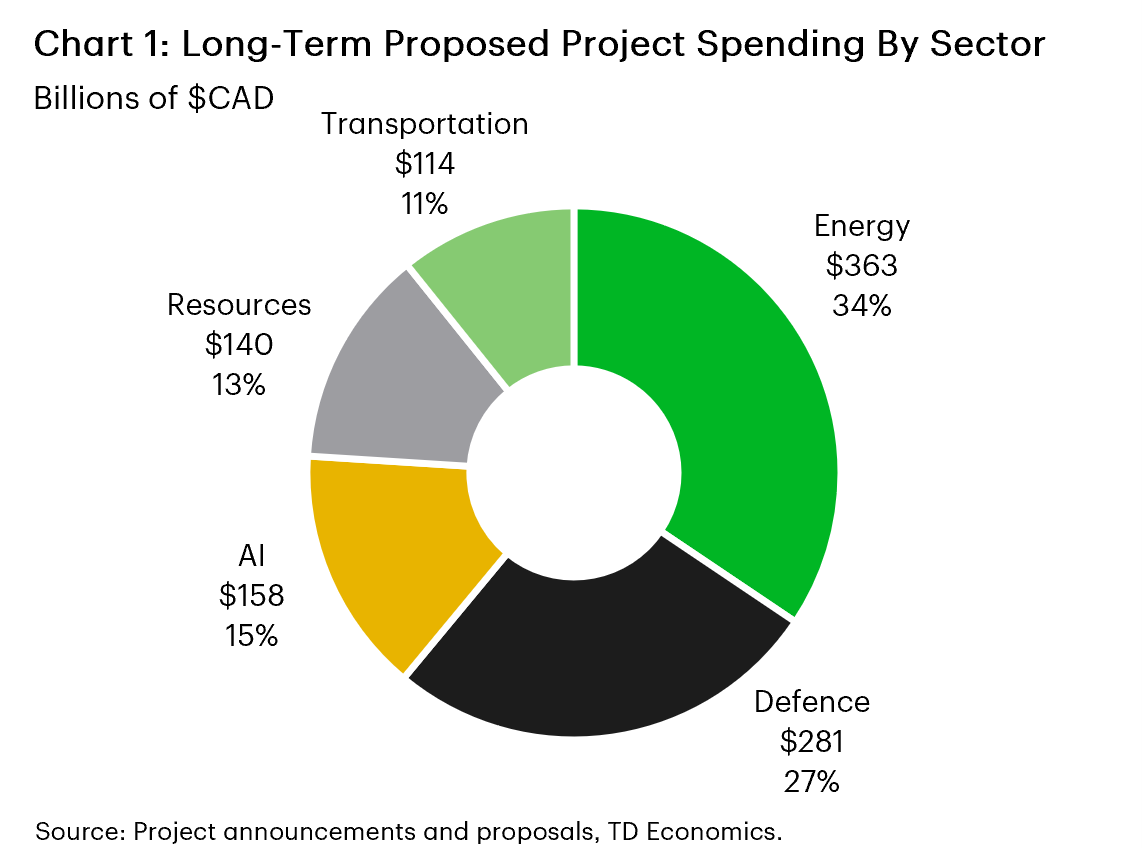
A thorough scan of early stage and proposed projects in five key sectors shows just over $1 trillion in estimated spending on 300+ publicly announced projects could be rolled out over the next ten-plus years. These all fall into our focus of analysis: energy, resources, AI, defence and transportation infrastructure. Our initial take was to upgrade our outlook for business investment in June (see report) to reflect some success by the Major Project Office in getting projects off the ground, further supported by the recent improvement in sentiment in the Bank of Canada’s Business Outlook Survey.
Chart 1 totals the estimated spending by sector. Energy, not surprisingly, accounts for over a third of the total dollar amount and the largest number of projects. This includes plans in both conventional oil and gas and the power sector, including proposals like Wind West, the Peace River Nuclear power project and the Alberta-B.C. oil pipeline. Defence includes projects like the NORAD modernization, while the resources sector has 86 mining projects at various stages of development. Transportation infrastructure includes investments in ports, rail, highways and bridges, resources are mining projects and AI are data centers.
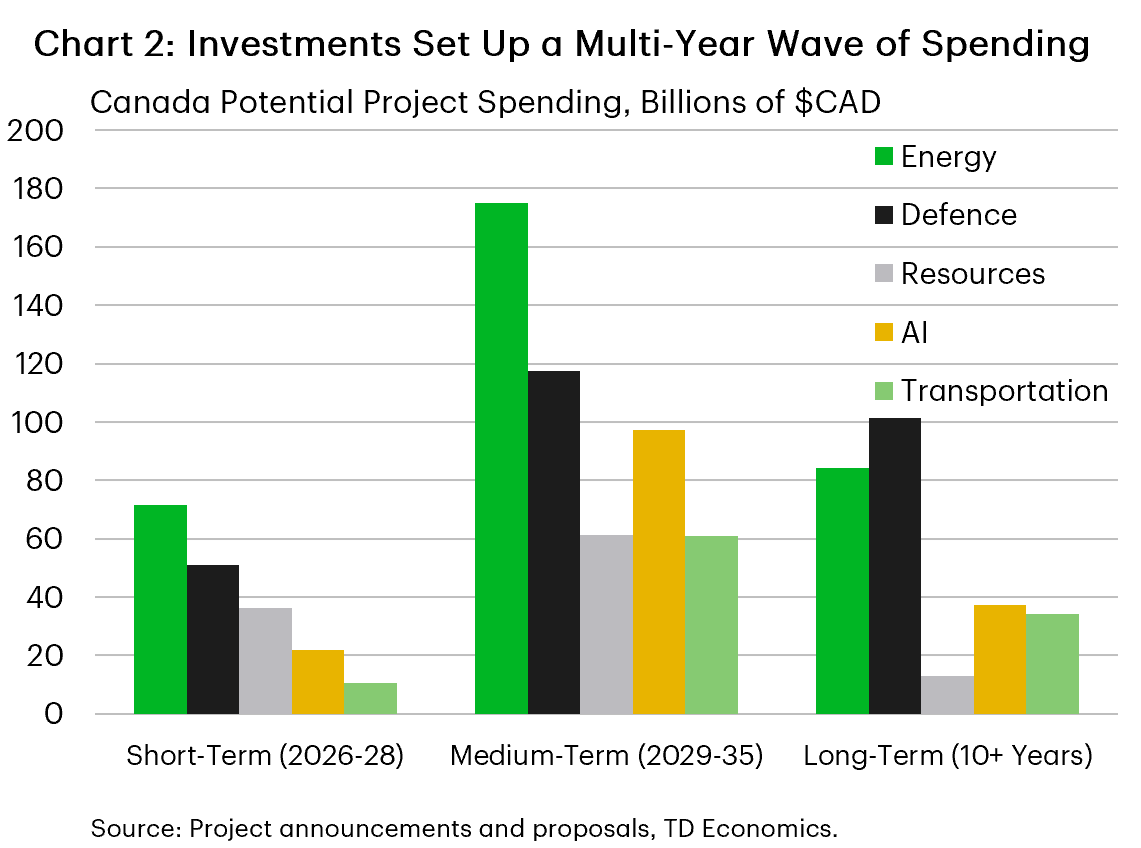
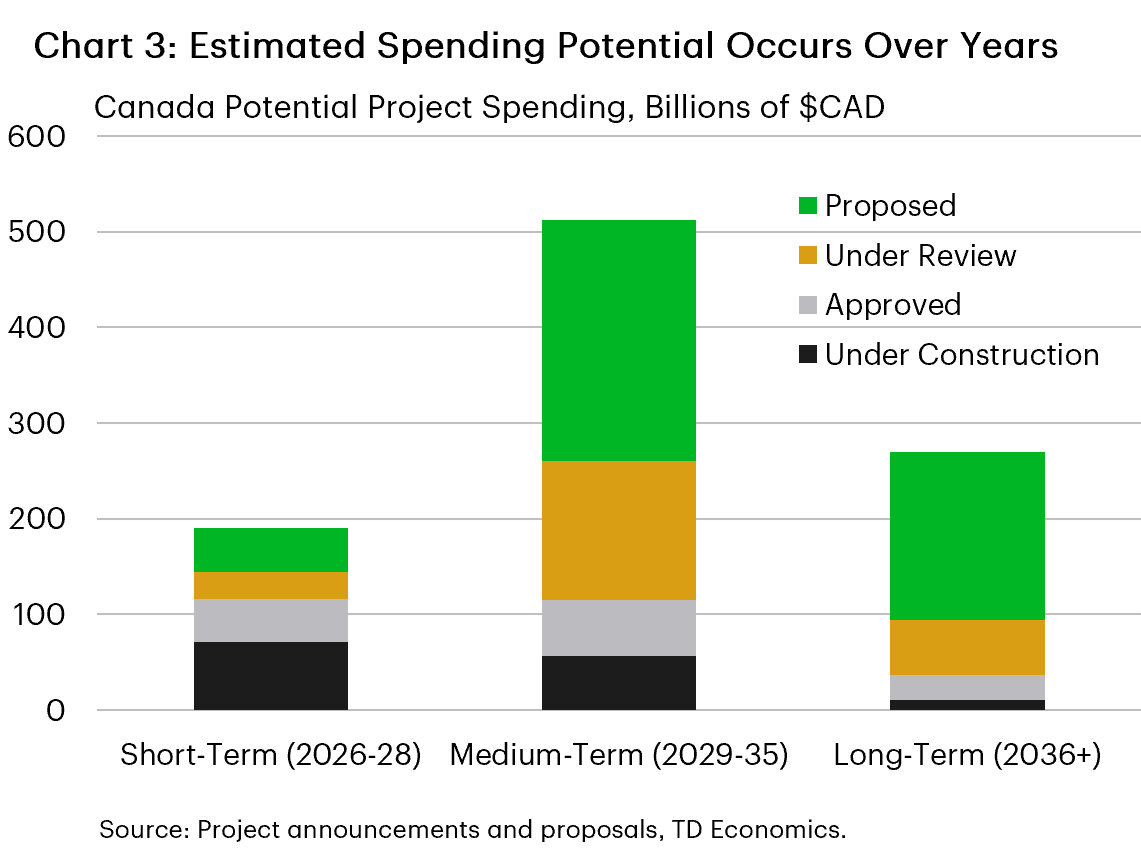
Charts 2 and 3 show how the projects by sector break out over time: within our two-year forecast window (over $190 billion), then over the medium timeframe of three-to-ten years (over $500 billion), and finally the likely spending that continues to support these projects beyond a 10-year window ($270 billion). Given the long time frames of these types of infrastructure projects, investment could be sustained as far as the eye can see, with a quarter of the spending estimated to be more than ten years away. Four categories for these projects were also created based on: under construction, approved (have regulatory approval but no construction), under review (have been submitted to regulators) and proposed, which means it is at a very early stage.
Flywheel Effect = Investment Supercycle
The $1 trillion in investment potentially on the docket could just scratch the surface of the possibility frontier. First, we’ve included only known proposals that are already in the public domain. But investment can beget more investment. If Canada executes well on major projects over the coming years, it will boost confidence in the private sector to undertake new projects without as much support from the public purse, driving a self-reinforcing feedback loop. This is the “flywheel effect”.
This dynamic is currently underway in the U.S. courtesy of an AI investment super-cycle. Despite Canada’s recent abysmal investment performance, it has a history of capital spending booms lasting up to a decade, largely tied to its resource sector. Look no further than the 2000-2010 period, when growth in real non-residential investment ran at an impressive 7% per year. The Bank of Canada noted three other multi-year commodity-driven supercycles in this country since the early 1900s1.
These share the same characteristics:
- Structural drivers: unlike a typical cyclical upswing, a super-cycle is fuelled by deeper forces. In the late 1990s/early 2000s, it was China’s ascendency that reverberated through global commodity markets alongside the IT boom. Today, Canada is well-positioned to benefit from structural global spending booms in those five areas noted earlier.
- Broad-based: investment is typically concentrated, then broadens over time.
- Self-reinforcing: economic returns from early investment create demand for further investment.
- Resource and capacity constraints: sustained high investment pushes against the limits of labor markets, commodity supply and productive capacity. This requires bold and supportive government policies to help keep the balling rolling in investment. More on this later.
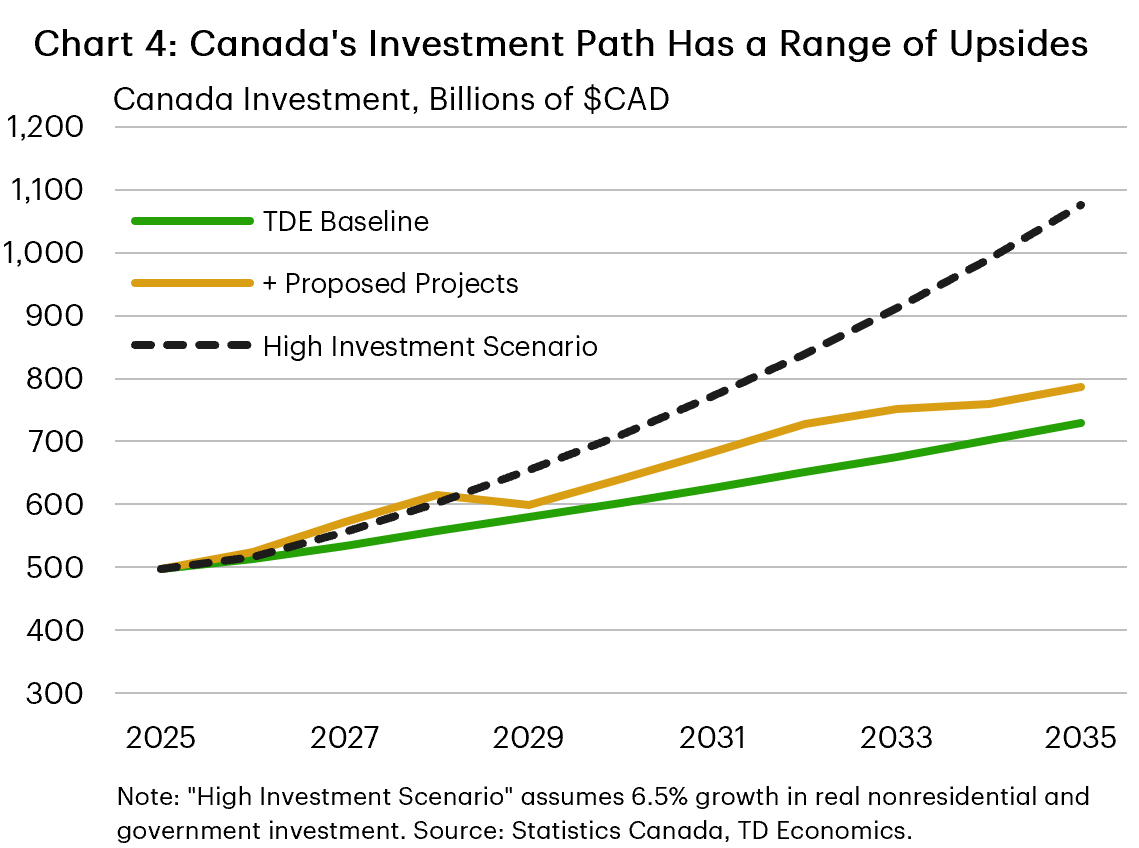
We show a “high investment scenario” in Chart 4 that captures this fly-wheel dynamic. In this projection, real investment sustains a 7% advance over the next decade, well above our current long-term baseline “run-rate” of roughly 2%. This is greater than implied by the project math alone. Under this scenario, nominal investment is roughly $1.5-1.7 trillion bigger over the next 10 years alone.
As we’ve noted, while much must go right to kick-off an investment supercycle, this pace has precedence. And it did so within a narrower group of industries relative to today’s broad and simultaneous focus on five areas.
An Investment Supercycle Would Supercharge Canadian Living Standards
A multi-year period of elevated investment would feed through to Canada’s economy broadly, setting the stage for higher productivity, incomes and government revenue. Perhaps most importantly, it would help to reverse Canada‘s sagging standard of living performance (real GDP per capita).
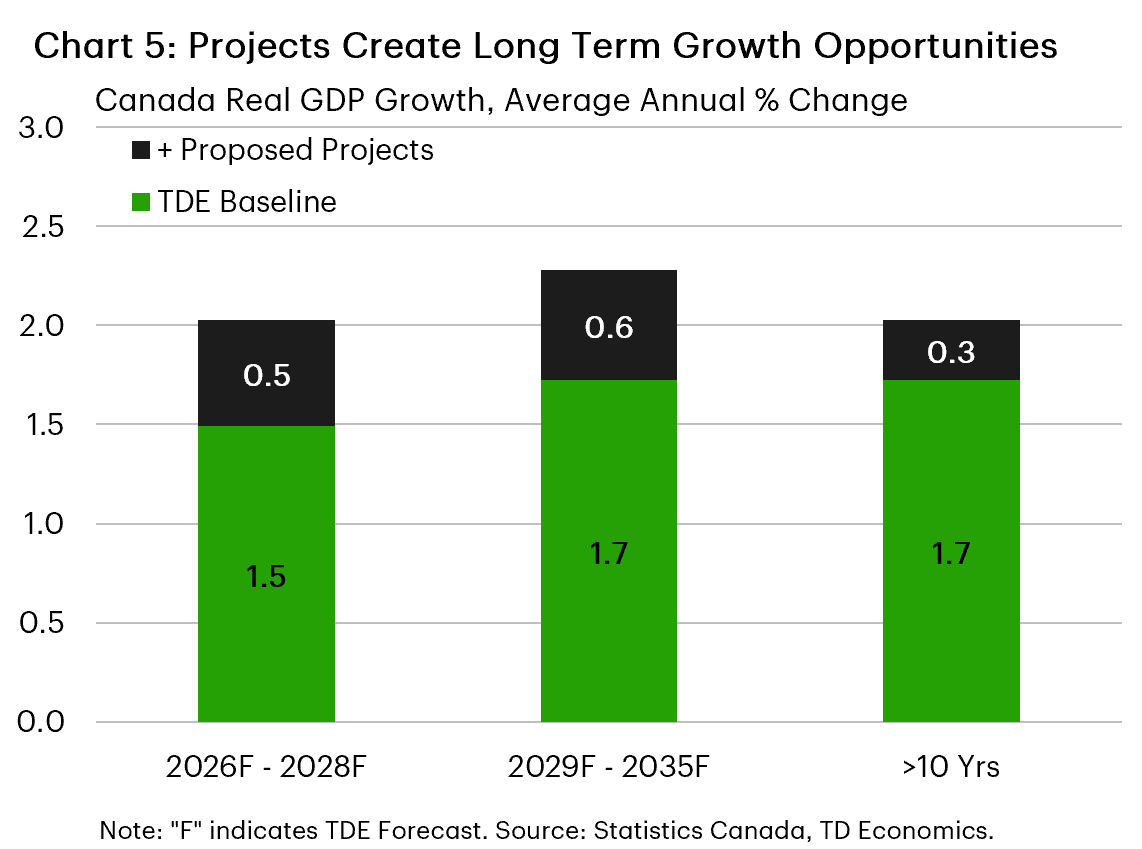
Chart 5 shows the impact to long-term growth if the publicly proposed projects go ahead. To arrive at these impacts, we have assessed how much of the aggregate spending would be on capital equipment and then apply Statistics Canada’s industry specific multipliers (induced effects) to estimate the potential upside to GDP. Canada’s real GDP growth would accelerate to an elevated 2-2.5% annually versus a one-handle currently in our baseline forecast (Chart 5).
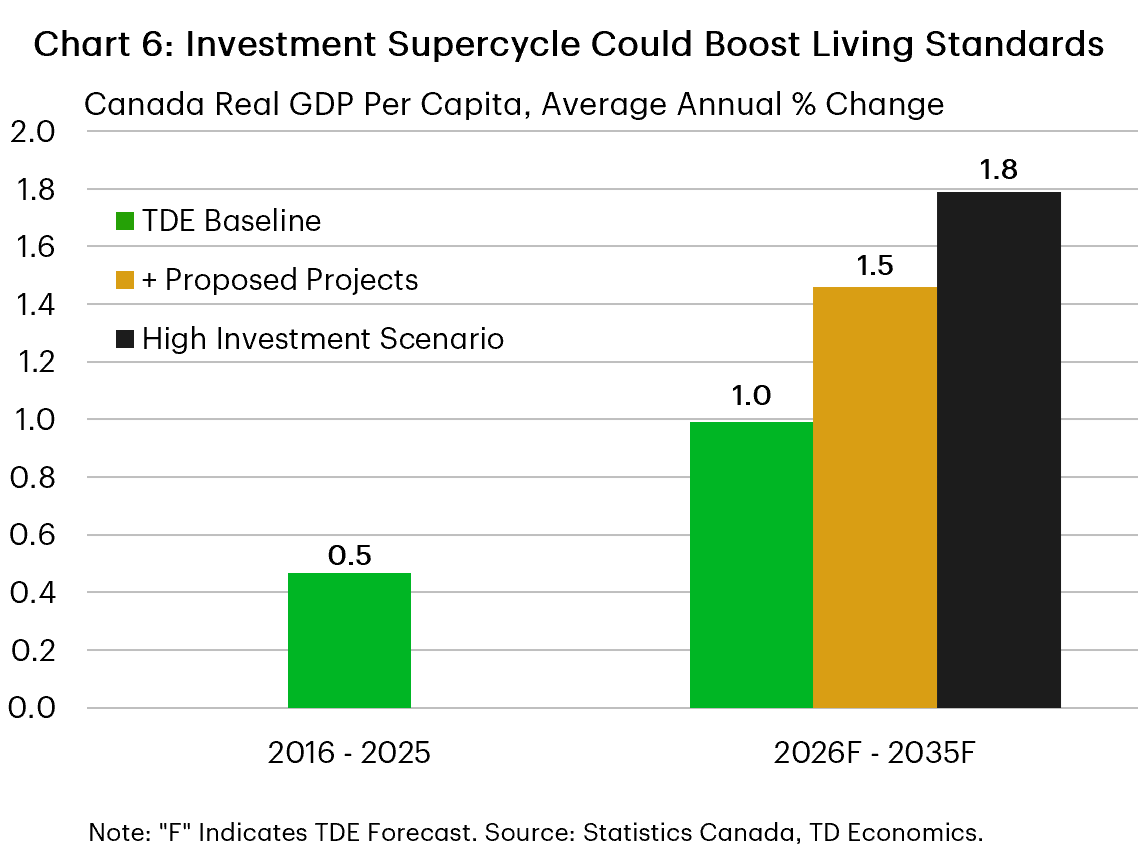
On living standards, Canada would also see a marked increase of almost 2% annually at the high end of our high investment scenario (7% growth in real investment), more than three times the meagre historical rate over the past decade (Chart 6). By comparison the average real output per Canadian would rise by about $12,000 by 2035 in the high investment scenario, double the growth in our baseline view.
Go Bold!
As already highlighted, given the prevailing global forces and the fact that Canada has a lot of what the world needs, conditions are ripe for an investment super-cycle. The only question is how to maximize this potential.
Past experiences with super-cycles underscore that bold policy moves were a key part of the equation. For example, investment was supercharged when Canadian governments moved to reduce royalties and lower corporate income and capital taxes in the 1990s and early 2000s. In the U.S., the current boom was initially kickstarted by the passage of the IRA and CHIPS and Science Acts that increased the incentive to onshore and invest, albeit at the cost of unsustainably high deficits in the absence of sufficient choices made on the other side of the ledger.
Turning back to the present, Canada must follow up its ambitious investment targets with even more ambitious ones around improving the economy’s competitiveness landscape. This is primarily on four fronts: lowering the regulatory wall for major projects, fixing tax disincentives, creating an environment where firms can scale, and expanding skilled labour capacity. If even partially successful in getting this right, less public funding (or taxpayer dollars) may be required because a natural private sector ecosystem is created. In other words, it’s less about available capital to invest and more about the ecosystem policymakers create to attract that capital organically.
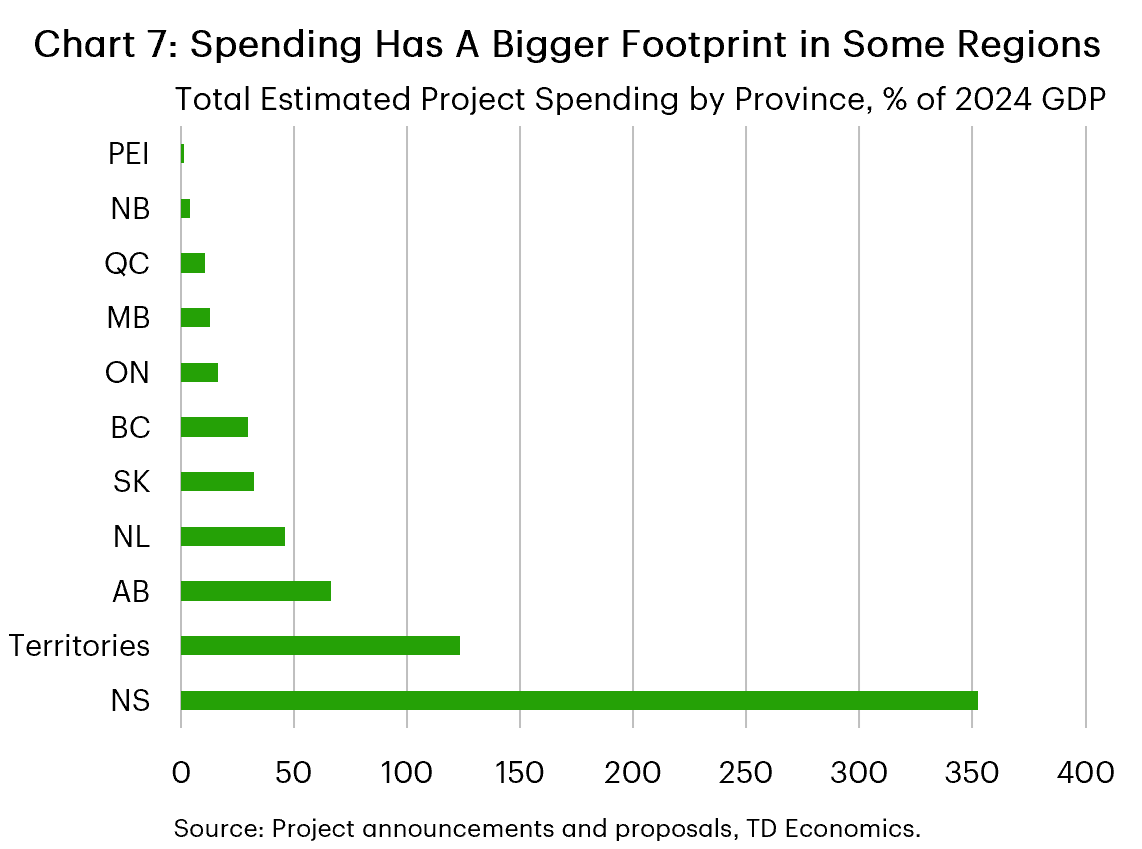
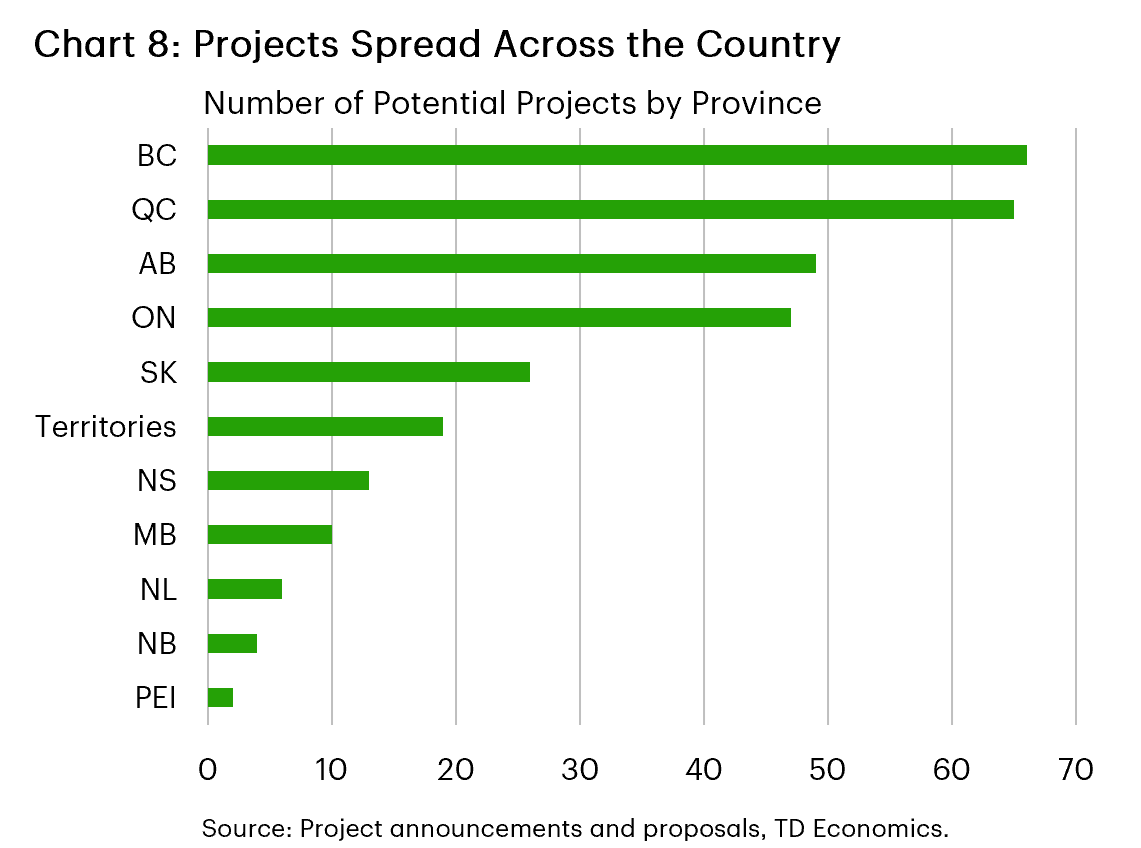
These issues extend well beyond federal jurisdiction – provinces have an important role to play in addressing challenges related to getting projects off the ground in every capacity. Expected project spending is disproportionately in the areas of resources, energy and defence. Geographically, these naturally skew towards Western Canada and Nova Scotia (Chart 7 & 8). For a supercycle to take hold across the country, provinces with fewer major projects may need to work harder to manifest a competitive environment to attract capital and labour.
Regulation Casts a Pall Over the Investment Environment
TD Economics has written about the role regulation plays in hamstringing competitiveness and investment. For energy, mining and infrastructure projects, long permitting timelines remain the clearest constraint on investment momentum. The problem predates 2019’s controversial federal Impact Assessment Act (IAA), with earlier environmental assessments similarly stretching across years. The IAA attempted to speed up the process by legislating permitting decision timelines to 180 days, but much of the delay still occurs outside the formal clock. Research from the Canada West Foundation in 2023 found that the initial planning phase took an average of 332 days to complete, despite the legislated target2.
Governments are trying to cut red tape. Ontario’s one-project, one-process model, the federal Major Projects Office, and the one-project, one-review framework all signal a desire to reduce duplication and streamline decisions. However, results matter in order for Canada to overcome the narrative that it is a difficult place to invest, particularly with projects that embed large capital expenditures and risk.
Indigenous consultation will remain central to this challenge. But there is an emerging model – one which both federal and provincial governments are championing by appointing dedicated subject matter experts on Indigenous consultation to support industry on identifying and connecting with impacted communities. This model includes, identifying and respecting those communities as self-governing equal partners, consulting early and broadly and on an on-going basis, and allowing for equity stakes and partnerships. Much of this work can and will be organized by government and there are a growing number of energy, resource, and infrastructure projects where success can be touted to investors.
Canada Could Increase Incentives to Grow
Both the personal and corporate sides of Canada’s tax system have idiosyncrasies that create barriers to growth. Canada’s top personal tax rates are high and apply at much lower income thresholds compared with the United States and other G7 countries. That matters for a small, open economy competing for entrepreneurs and talent. The gap is especially visible when comparing the highest tax jurisdictions, say Ontario, with comparable U.S. states, where top rates often bind at much higher income levels. There is little doubt that higher wages abroad and lower tax rates contribute to talent locating elsewhere. The Institute for Canadian Citizenship’s Leaky Bucket report3 showed that onward migration rates are highest among immigrants with doctoral degrees, strong earnings potential and experience in high-demand occupations, including ICT, engineering and in the sciences.
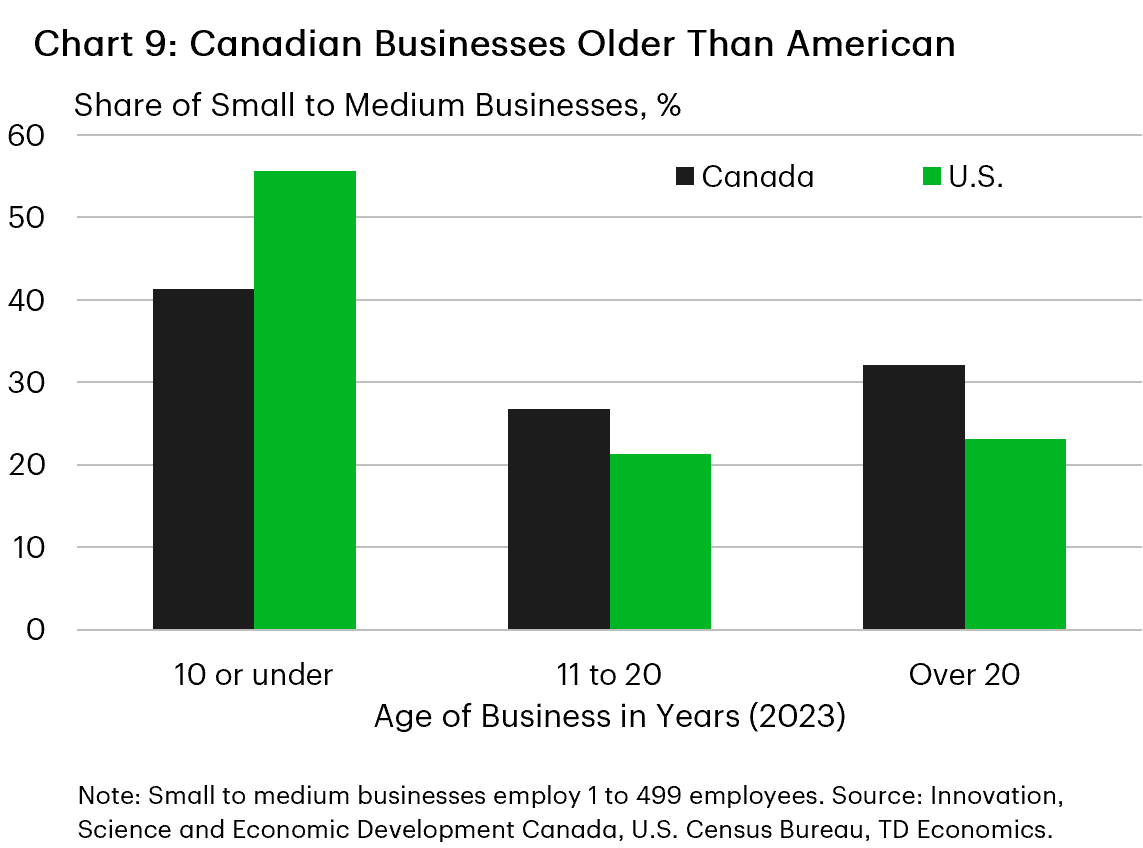
The business tax system creates disincentives as well. Rather than encouraging creative destruction, technology adoption and scaling, Canada’s mix of small-business preferences, tax credit phase-outs and Canadian-Controlled Private Corporation rules can reward staying small or engaging in aggressive tax planning rather than positioning for growth. As a result, firms tend to be far older than their American counterparts, suggesting a lack of dynamic new business creation (Chart 9). High-growth firms account for a disproportionate share of job creation and output. Research in the U.S. show that the top performing 10% of firms account for roughly half of gross output and 60% of gross job creation4 in a given year! And the firms that matter most are often young, not simply small.
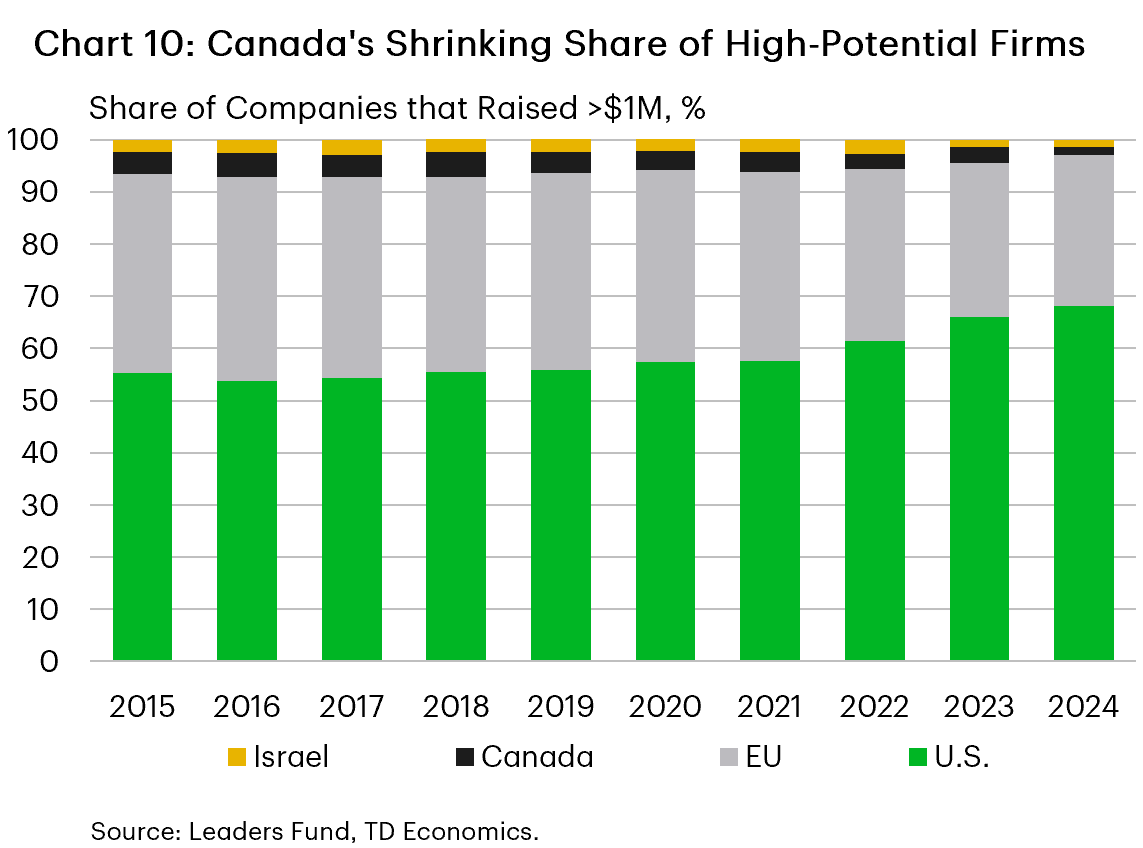
Canada also has fewer sources of growth-stage financing than the United States, which is a challenge to generating and retaining high-growth firms. Canadian-founded firms increasingly rely on foreign investors as they scale, notably from the U.S., and many eventually move south to have easier access to deeper capital pools, larger markets and stronger networks. Canada’s share of high-growth firms has gradually eroded over the last 10 years. According to the Leaders’ Fund estimates, Canada’s share of high-growth companies across Canada, the U.S., the EU, and Israel has fallen from 4.7% in 2016 to only 1.5% in 2024 (Chart 10). Canadian high-growth firms also attract less funding, with those that move to the U.S. being able to raise nearly double the amount of funding, such that by between 2016 and 2024, the number of high-potential companies founded by Canadians that remained in Canada fell from 74.9% to 32.4%.5
Canada’s scale-up problem partly reflects a broader ecosystem gap: insufficient growth capital, weak commercialization of research done at the post-secondary education level, tax and regulatory frictions, and limited pathways for promising firms to become global leaders. There will always be natural competitive advantages within the U.S. due to its sheer market size, both financial and demand. This makes it all the more crucial that Canadian policymakers address domestic barriers that lay within their control.
Skilled Labour a Binding Constraint
Ensuring Canada has enough workers with the right skills to deliver on its investment ambitions will also be crucial. Construction alone is expected to need hundreds of thousands of workers over the next decade, driven by retirements and new demand. Major project build outs will also compete with housing and general infrastructure renewal for the same pool of tradespeople, engineers, project managers and technical specialists.
Federal and provincial governments have indeed expanded support for skilled trades through training grants, wage subsidies, certification support and efforts to improve interprovincial mobility and to encourage more Canadians to go into the trades. And optimizing the domestic labour pool will help significantly in addressing a potential gap. Still, higher structural demand may need some intervention through the immigration channel. Caution is warranted here. Canada’s recent experience with non-permanent residents, some of which came through in construction streams, resulted in heightened pressures on social infrastructure, requiring a policy U-turn that is still mid-flight. Time will tell if government measures around supporting skilled trades within the country are sufficient to generate a step change in job growth in these sectors. Absent that, labour shortages could become the practical constraint that prevents Canada from converting investment intentions into completed projects.
The Bottom Line
“The world is your oyster”! If policymakers in Canada play their cards right, the country may be on verge of a multi-year investment supercycle not unlike what was enjoyed in the early 2000s. Current secular forces at play across five key sectors – oil, critical minerals/resources, transportation infrastructure, defence and AI – have the potential to kickstart an investment boom of as much as $1.5-1.7 trillion over the next decade and beyond. A bold policy response will be a key part of the equation. Nibbling around the edges of past policies is unlikely to do the trick. The over-riding goal should be to create a natural private investment ecosystem over time that will reduce the need for public subsidies.
End Notes
- https://www.bankofcanada.ca/wp-content/uploads/2016/11/boc-review-autumn16-buyuksahin.pdf
- https://cwf.ca/research/publications/report-federal-impact-assessment-act-under-review
- https://forcitizenship.ca/the-leaky-bucket
- https://www.census.gov/content/dam/Census/library/working-papers/2017/adrm/carra-wp-2017-03.pdf
- https://leaders.vc/research/canadianstartups
Disclaimer
This report is provided by TD Economics. It is for informational and educational purposes only as of the date of writing, and may not be appropriate for other purposes. The views and opinions expressed may change at any time based on market or other conditions and may not come to pass. This material is not intended to be relied upon as investment advice or recommendations, does not constitute a solicitation to buy or sell securities and should not be considered specific legal, investment or tax advice. The report does not provide material information about the business and affairs of TD Bank Group and the members of TD Economics are not spokespersons for TD Bank Group with respect to its business and affairs. The information contained in this report has been drawn from sources believed to be reliable, but is not guaranteed to be accurate or complete. This report contains economic analysis and views, including about future economic and financial markets performance. These are based on certain assumptions and other factors, and are subject to inherent risks and uncertainties. The actual outcome may be materially different. The Toronto-Dominion Bank and its affiliates and related entities that comprise the TD Bank Group are not liable for any errors or omissions in the information, analysis or views contained in this report, or for any loss or damage suffered.
Download
Share: