Highlights
- Canadian consumers are holding up reasonably well, with solid spending growth and tentative signs of stabilizing insolvency rates, although pockets of credit stress remain.
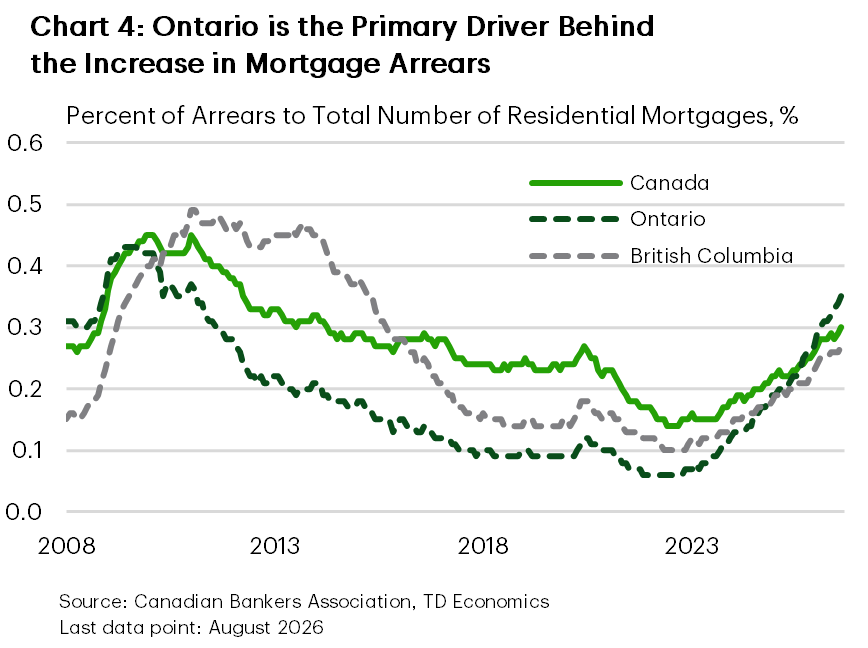
- Ontario stands out with mortgage arrears nearly tripling from pre-pandemic norms and approaching their Global Financial Crisis peak. This reflects elevated mortgage balances and greater sensitivity to borrowing costs.
- Looking ahead, our outlook for stronger economic growth in 2027 offers some reassurance. We expect Ontario’s mortgage arrears to stabilize around mid-year before gradually declining.
Canadian consumers held up well through the first half of the year, with real consumer spending growing at a nearly 3% pace. But solid spending growth masks pockets of financial strain, particularly in Ontario. A closer look at several indicators – insolvencies, delinquencies, and mortgage arrears – reveals a mixed picture, with some measures showing signs of stabilizing while others continue to deteriorate. Nevertheless, stronger economic growth and a recovering labour market in 2027 should help contain financial stress and prevent a broader deterioration in household credit performance.
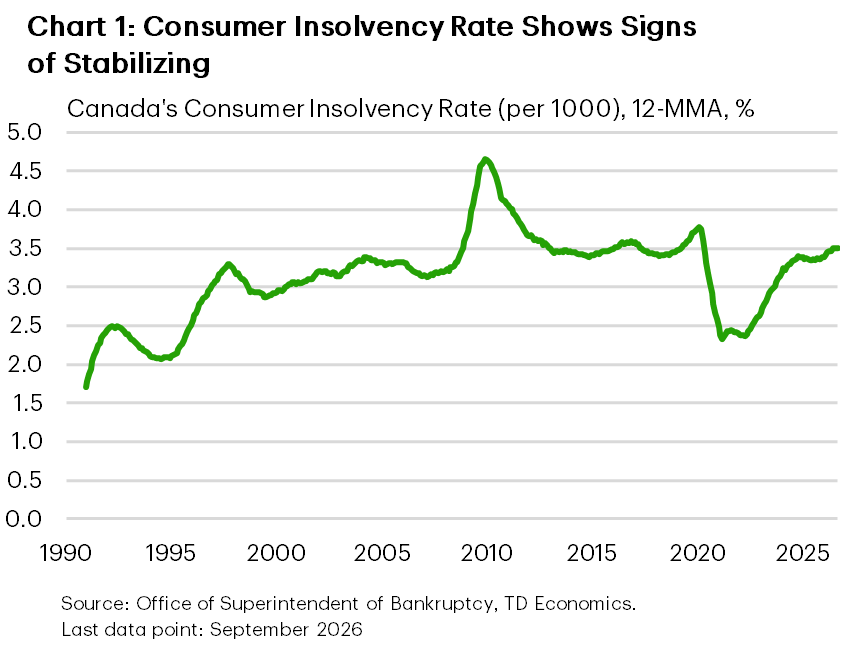
Consumer insolvencies – one of the more severe manifestations of financial distress – offer a useful starting point. Nationally, the insolvency rate remains well below the levels seen in the aftermath of the Global Financial Crisis (GFC) but it has trended upward since the interest rate hiking cycle began in 2022 (Chart 1). Although the rate showed signs of stabilizing in recent months, the latest reading suggests a renewed upward pressure, warranting close monitoring.
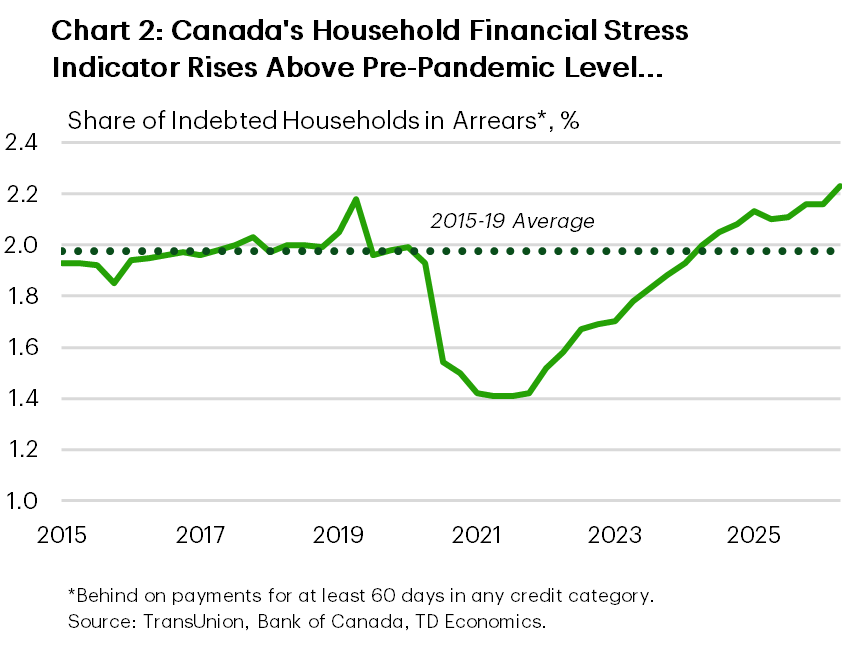
 Delinquencies offer an earlier read on emerging credit stress. TransUnion’s financial stress indicator, also tracked by the Bank of Canada, measures the share of consumers who are at least 60 days delinquent in any credit category (Chart 2). The series only extends back to 2015, preventing a comparison with the GFC, but it shows a steady deterioration since Q3 2021. By Q2 2026, the indicator had reached a new high of 2.23%, roughly 25 basis points above its pre-pandemic average. Given that delinquencies tend to precede insolvencies, the elevated level of delinquency rates suggests that insolvency rates could face further upward pressure.
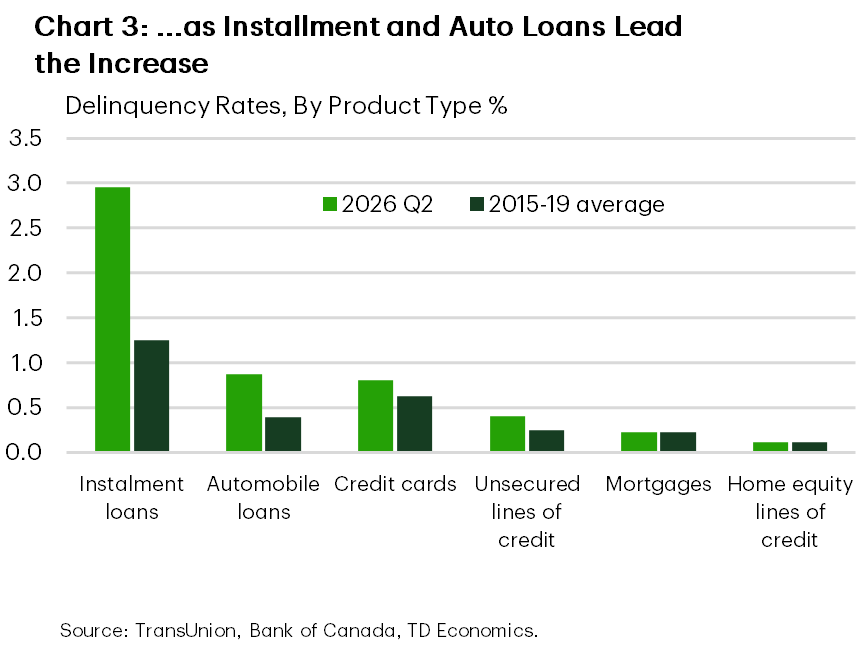
As is often the case, aggregate figures mask pockets of weakness across credit products and regions. Delinquency rates on installment and auto loans have climbed well above their 2015–19 averages and continue to rise (Chart 3). Credit card and unsecured line-of-credit delinquencies are also slightly elevated, although both show more convincing signs of stabilizing. Meanwhile, delinquencies on debt secured by real estate remain broadly in line with pre-pandemic norms nationally.
Ontario is Where the Cracks are Most Visible
Mortgage arrears have risen considerably in Ontario and, to a lesser extent, in British Columbia. Both provinces experienced particularly strong home price gains during the pandemic, leaving many households with larger mortgage balances relative to their incomes. As borrowing costs rose, servicing those balances became more expensive, leaving less room to absorb financial shocks. More recently, the pace of increase British Columbia’s mortgage arrears rate has slowed, while Ontario’s rate has continued to climb. At 0.34% in August, Ontario’s mortgage arrears rate has nearly tripled from its pre-pandemic norm of 0.12% and is approaching the 0.43% peak recorded during the GFC (Chart 4).
Still, perspective matters. Even at today’s elevated rate, roughly one in 300 Ontario mortgages is in arrears. These missed payments do not necessarily translate into more severe financial distress or credit losses. Many borrowers retain substantial home equity, giving both households and lenders some flexibility to manage financial difficulties. The greatest vulnerability likely lies among those who purchased near the 2021-22 housing market peak, when prices were highest and equity cushions may be thinnest.
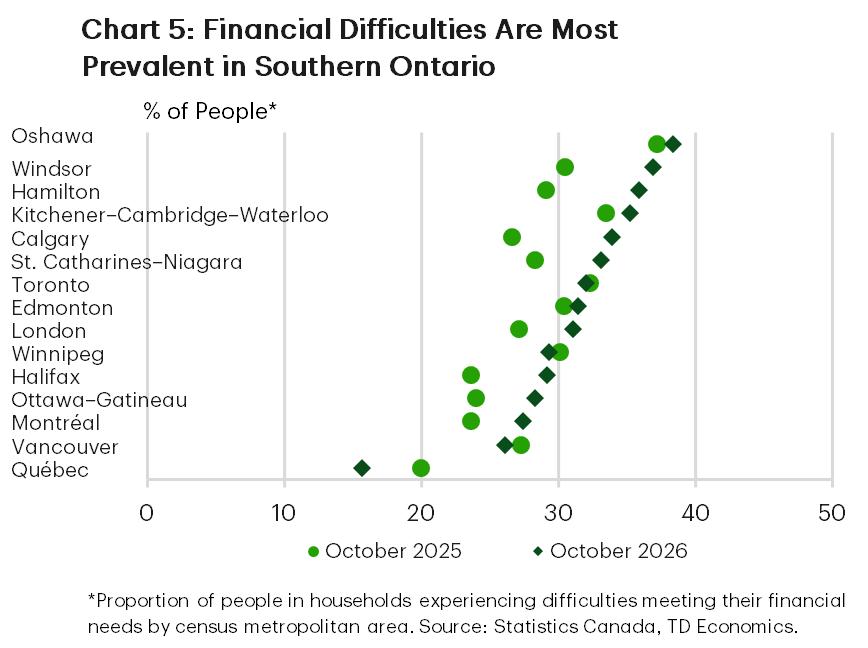
Household survey data reinforce this picture of rising strains in Ontario. According to Statistics Canada, financial difficulties are most prevalent in Southern Ontario, where households continue to face a combination of elevated living costs and a weakening labour market (Chart 5). Notably, more than 35% of people living in households in Oshawa, Windsor and Hamilton report difficulties meeting their financial needs – the highest among Canada’s largest cities. Unemployment rates in all three cities are also above the national average, underscoring how labour market weakness is compounding existing affordability pressures in some regions.
The Labour Market Remains the Bigger Swing Factor
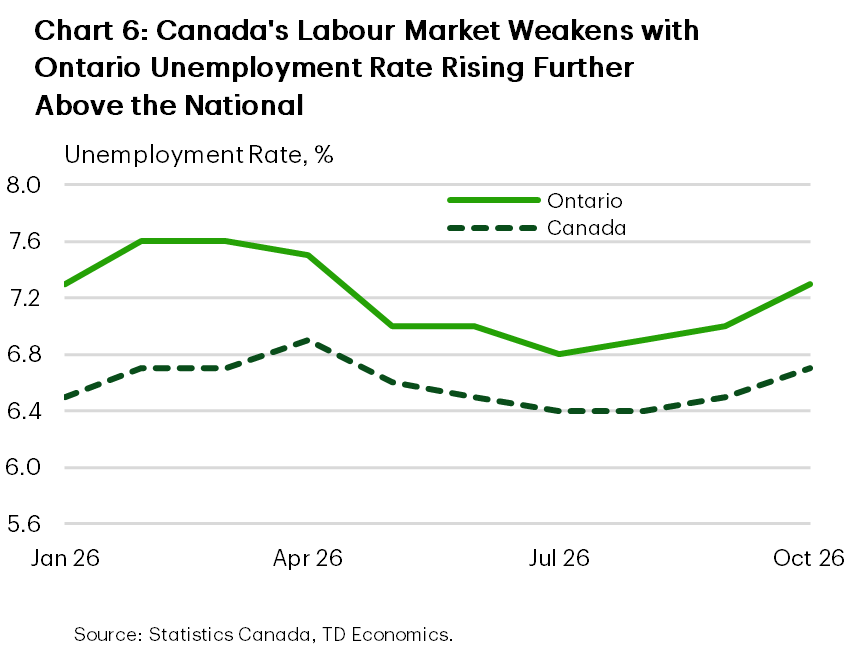 The labour market holds the key to how household financial stress evolves from here. Canada’s economy lost jobs for a third consecutive month in October, with Ontario contributing the most to the recent losses. The province’s labour market has lost momentum in recent months after showing some resilience earlier in the year (Chart 6). However, at 7.3%, the unemployment rate remains below last year’s peak of 7.9% but is still above its pre-pandemic trend of around 6%. For now, Canada’s main concern is weak hiring rather than widespread layoffs, with renewed trade-related uncertainty reinforcing employers’ reluctance to add staff, particularly in Ontario.
Looking ahead, our forecast anticipates stronger economic and employment growth in 2027, supported by an improvement in labour market conditions both nationally and in Ontario. Given that mortgage arrears typically lag changes in unemployment by two to three quarters, we expect Ontario’s arrears rate to plateau around mid-2027 before gradually declining in the second half of the year.
Higher borrowing costs aren’t going away
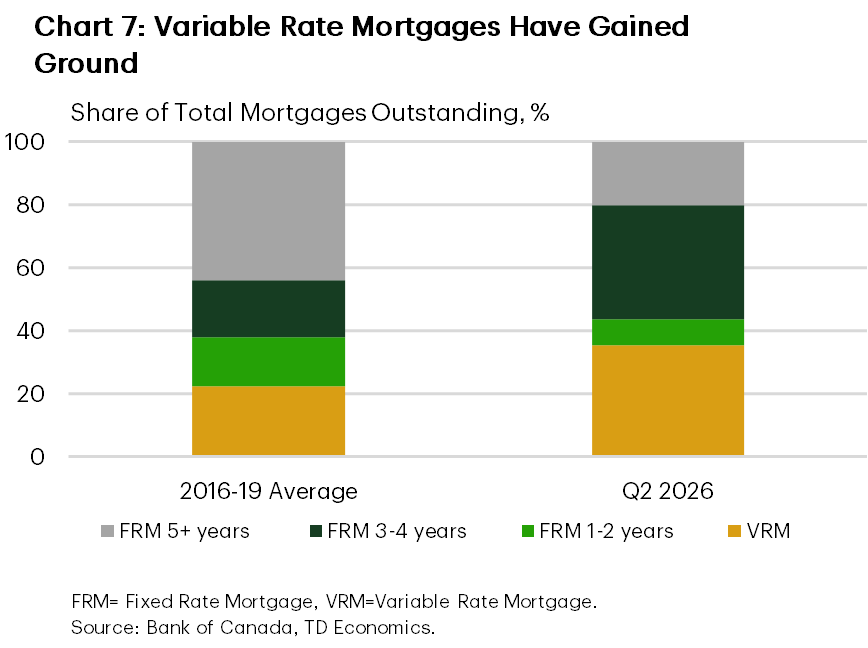
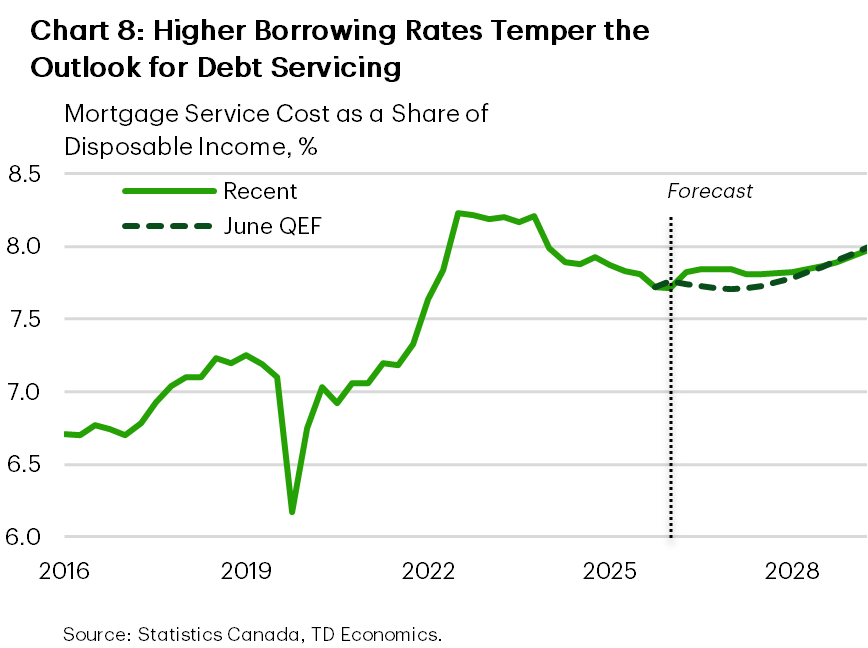
The Bank of Canada raised its policy rate by 25 basis points in October to guard against persistent inflation, with another increase expected in January. Policy rate changes feed through to lenders’ prime rates and, in turn, to variable-rate mortgages, which now account for a historically high 35% of outstanding mortgages (Chart 7). Borrowers with adjustable payments feel the impact immediately, while those with fixed payments experience it more gradually, as a larger share of each payment goes toward interest, potentially extending amortization periods. Fixed-rate borrowers are also facing renewed pressure. The five-year Government of Canada bond yield, a key benchmark for fixed mortgage pricing, has risen by roughly 60 basis points this year, translating into higher borrowing costs for households renewing their mortgages or entering the housing market.
Bottom Line
Despite these vulnerabilities, we see little reason to sound the alarm bell over a broader deterioration in household credit performance. Ontario’s mortgage arrears are rising but are forecast to decline next year as the economy improves. The risk to this outlook is clear: if weak hiring gives way to widespread job losses, pushing the unemployment rate higher, mortgage arrears could rise further and remain elevated for longer. But with stronger economic growth and a recovering labour market in our forecast, households in Ontario and across Canada are expected to bend, but not break.
Disclaimer
This report is provided by TD Economics. It is for informational and educational purposes only as of the date of writing, and may not be appropriate for other purposes. The views and opinions expressed may change at any time based on market or other conditions and may not come to pass. This material is not intended to be relied upon as investment advice or recommendations, does not constitute a solicitation to buy or sell securities and should not be considered specific legal, investment or tax advice. The report does not provide material information about the business and affairs of TD Bank Group and the members of TD Economics are not spokespersons for TD Bank Group with respect to its business and affairs. The information contained in this report has been drawn from sources believed to be reliable, but is not guaranteed to be accurate or complete. This report contains economic analysis and views, including about future economic and financial markets performance. These are based on certain assumptions and other factors, and are subject to inherent risks and uncertainties. The actual outcome may be materially different. The Toronto-Dominion Bank and its affiliates and related entities that comprise the TD Bank Group are not liable for any errors or omissions in the information, analysis or views contained in this report, or for any loss or damage suffered.
Download
Share: