Tankers, Talk and Trade-offs: Interest Rate Drivers
Beata Caranci, Senior Vice President & Chief Economist
Andrew Hencic, Director & Senior Economist | 416-944-5307
Date Published: October 20, 2026
- Category:
- Canada
- Financial Markets
Highlights
- The U.S. yield curve is priced for higher-for-longer inflation and interest rates, and the repercussions are spilling into global yields.
- It’s not the high level of energy costs that matters, but its persistence that risks businesses passing them on to consumers.
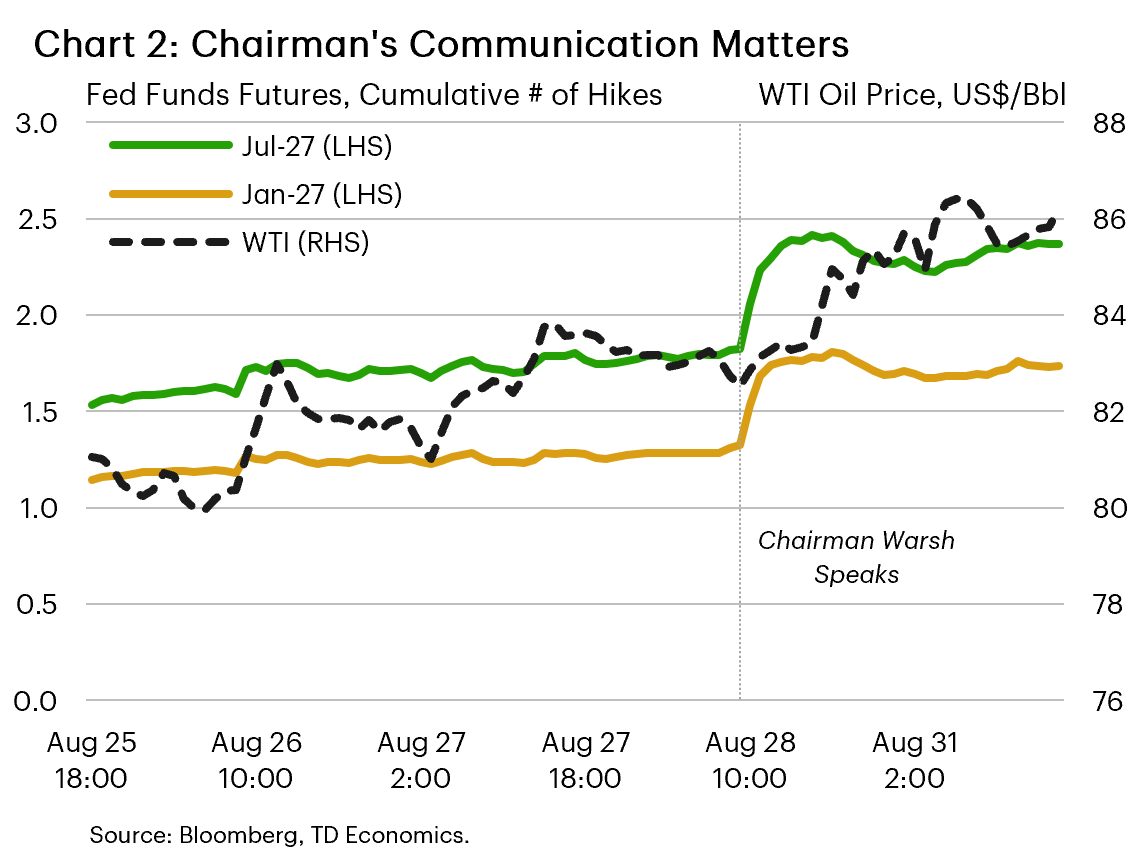
- Federal Reserve communication has reinforced the market’s take on inflation and rate-hike expectations.
- Although bond markets are becoming more price-sensitive to fiscal-sustainability risks globally, Treasuries have been spared.
- But shifting international sentiment is a cautionary tale to preserve fiscal credibility as debt-servicing costs trek higher.
Many factors play into moving yields across the U.S. Treasury curve, but the upward shift in the past couple of months is almost exclusively due to market participants placing higher bets on interest rate hikes. In July, there was an expectation for the policy rate to settle at 4.00% by the end of 2027. That now stands at 4.50%. As Treasury yields rose, so too did the yields of other countries. Two forces interconnected within the U.S. are rippling to the rest of the world: (1) energy prices and pass-through risks; and (2) central bank communication. A third factor, fiscal sustainability, has had limited impact on U.S. domestic yields, but is no longer a remote risk. Shifting market sentiment has fired off a warning flare — punishing French bonds for outsized government deficits and debt. We break it down.
Topping the list: energy costs
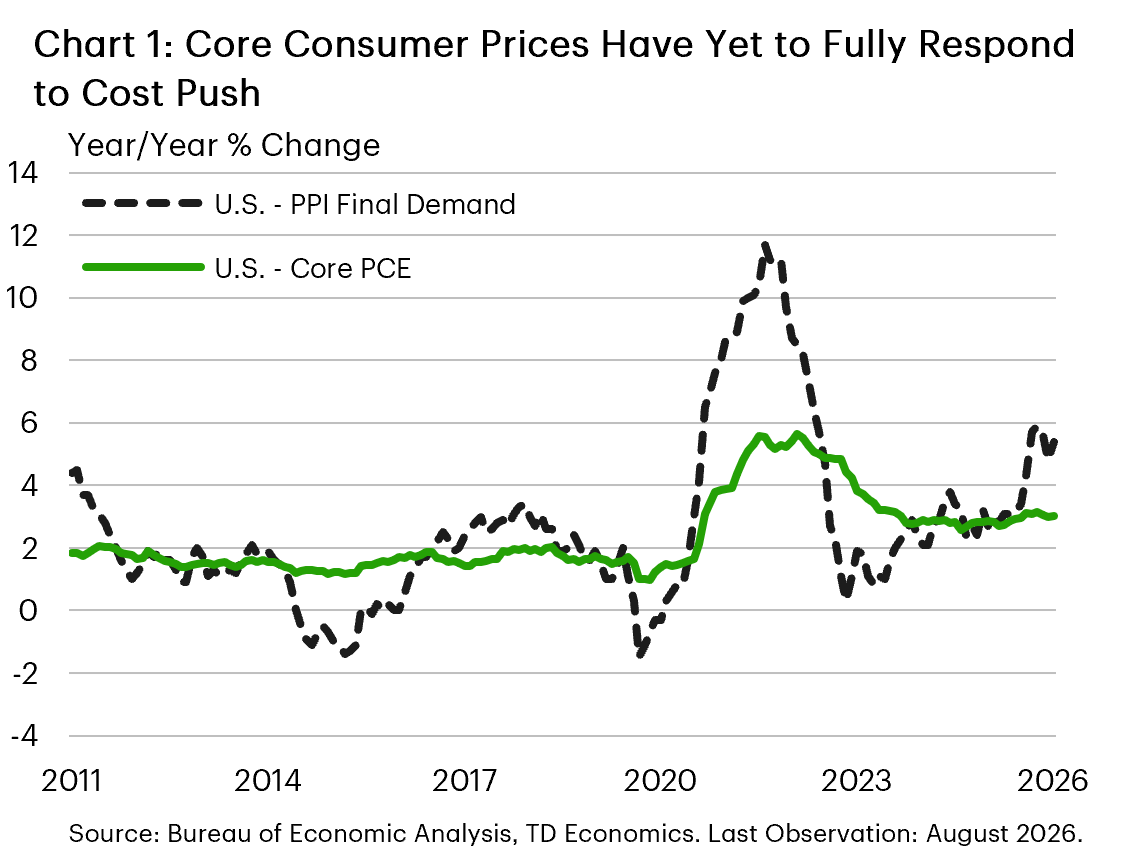
When it comes to high oil prices, the risk-factor for inflation is not that it breached $100 in September or that it is up 40% since late-February. Companies do not typically pass along price spikes to consumers if believed temporary. But time is no longer on our side. Imbalances in processing and inventory levels (oil, gas and diesel) have spanned months, with no clear off-ramp on the Iran conflict. Even when that occurs, it will take time to rebuild global inventories. This has led markets to recalibrate bond yields to the possibility that corporate America will not be able to hold-the-line on consumer prices for much longer. Up until now, core PCE inflation data offers little evidence that companies have opted to pass on higher input costs (Chart 1). But the risk grows with each passing month, and markets are sending a clear signal.
This is compounded by a strong economy acting as a double-edged sword. The U.S. expansion is expected to be near 3% in the third quarter of this year makes it more appealing for companies to raise prices amidst strong domestic demand, solid wage growth, and capacity constraints. This combination was validated by the Federal Reserve in September. The decision to raise interest rates by a quarter point embeds the belief that the economy can support higher interest rates to head off the temptation, or necessity, of higher consumer prices.
 Walking the Walk
Beware the Fiscal Thunderclouds
 So far, running government deficits of more than 5% of GDP has been shrugged off by the Treasury market. This is, in part, because the U.S. reflects considerable economic strength relative to peer countries, and a trillion dollars in government spending cuts are on deck in 2027 and through the next decade. But the risk lingers that attention pivots back to the government’s debt balance. Doing so would further raise yields.
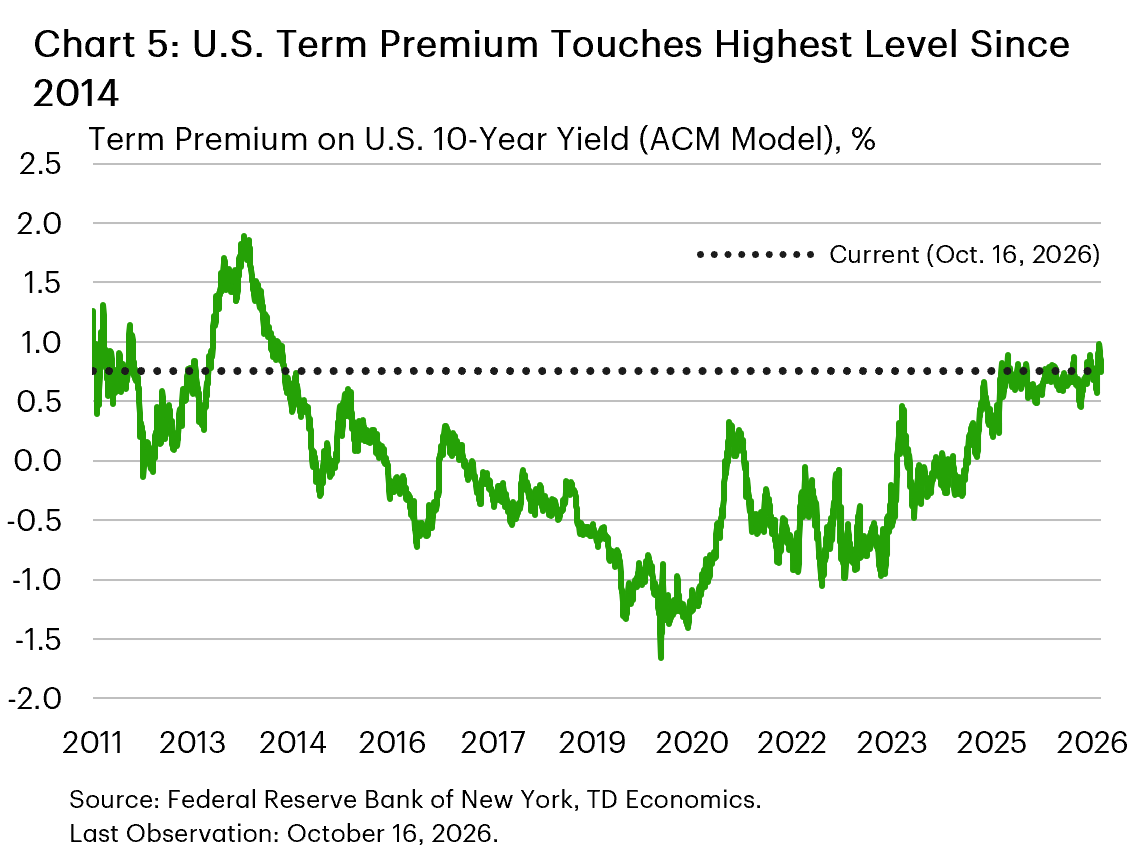
This is currently unfolding in France, where 10-year borrowing costs have risen 160 basis points since late February, widening spreads off German debt to the highest level since 2012. France is a stark reminder that debt still matters, particularly in the absence of a convincing path back to fiscal sustainability. Investors are imparting the “yield penalty” through the term premium — the extra compensation they require for holding long-term bonds rather than rolling over a series of short-term bonds.
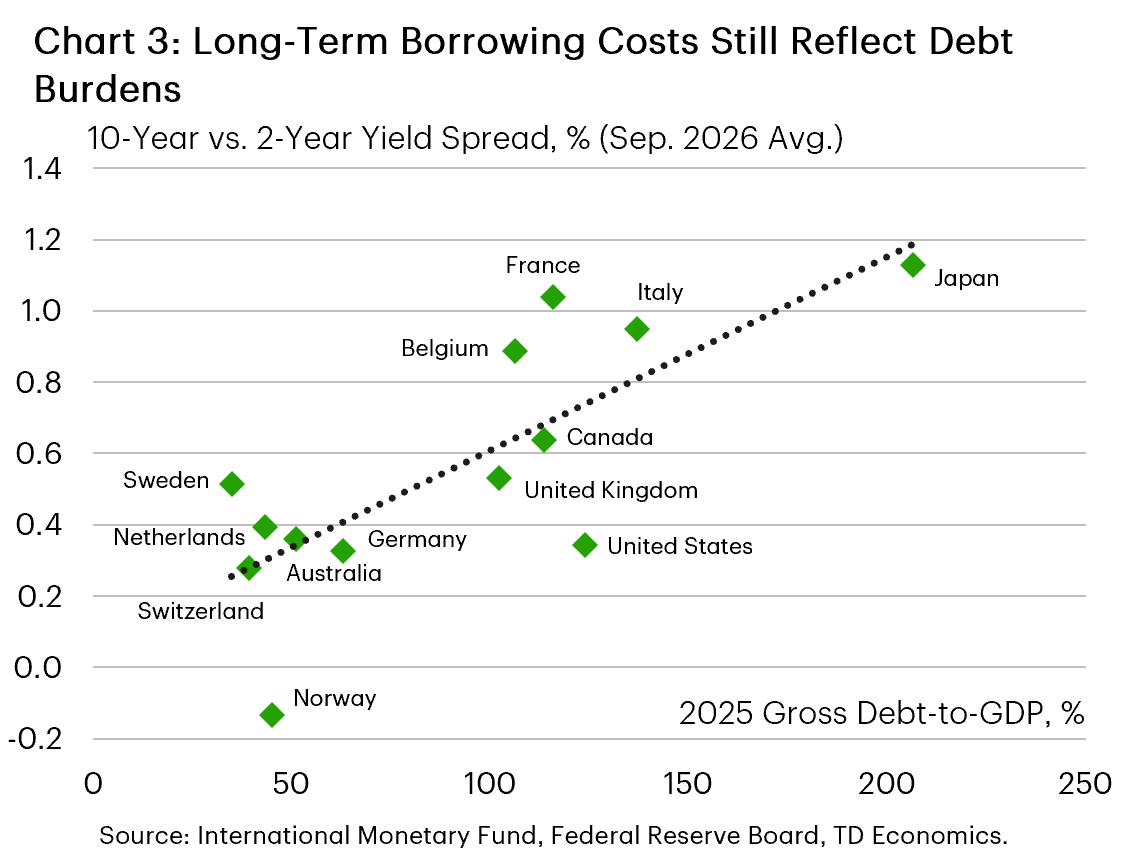
So far, the U.S. maintains its safe haven status, with a lock on market confidence and credibility. Relative to the size of its debt, the yield penalty is small when compared to other countries. This is evident by comparing the difference between 10-year and two-year borrowing costs, which acts as a proxy for the additional compensation investors are demanding. Chart 3 shows that the U.S. premium is compressed relative to its stock of government debt. The spread on U.S. borrowing is in line with that of Australia, a country with a debt-to-GDP ratio 70 percentage points lower.
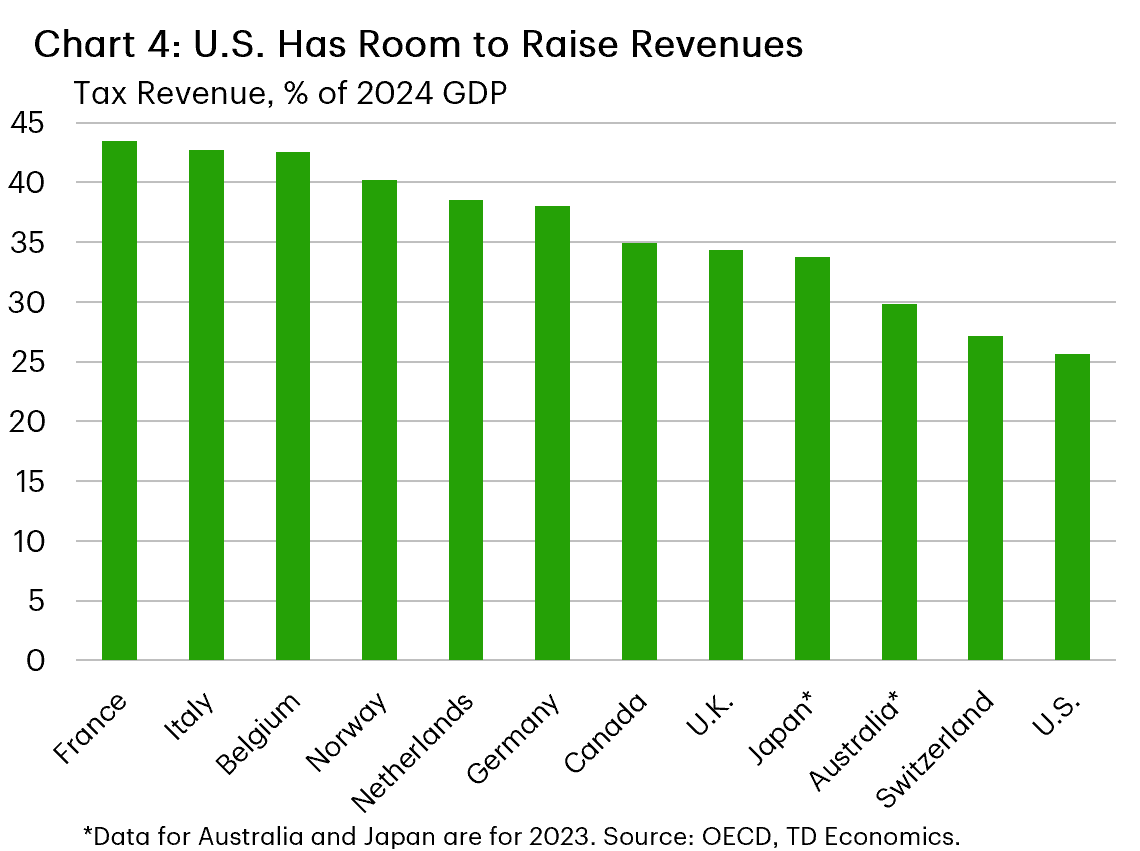
The borrowing advantage reflects a variety of factors: the dollar being the global reserve currency, the deep pool of safe Treasuries, nominal GDP growth outpacing interest costs in the near-term, and a low ratio of tax revenues as a share of GDP compared to other countries (meaning there is theoretical space for tax increases, Chart 4).
The opposite is true in France. The country is gripped in a low-growth, high-debt paradigm, with little expected fiscal reform in the future. It’s unsurprising then that investors are demanding a premium for the additional risk.
The scale of the U.S. advantage is impressive, but not immune to market forces. The profile of Treasury holders has shifted from stable buyers (generally central banks) to more price sensitive holders (like hedge funds, commercial banks, households and other private investors). Should a slowdown in nominal GDP growth occur, it would challenge the math on the sustainability of large and persistent deficits. When combined with more price sensitive investors, shifts in sentiment could have outsized implications for interest rates.
Naturally, slower economic growth would also reduce the expectations for interest rate hikes. But fickle markets could offset part or all of this by demanding a fatter term premium. This would increase the government’s interest burden at a time when the economy’s ability to service it is slowing. There was a glimpse of this dynamic in recent weeks when estimates of the U.S. term premium rose 30 basis points, touching the highest levels since 2014 (Chart 5).
Canada at a Crossroads
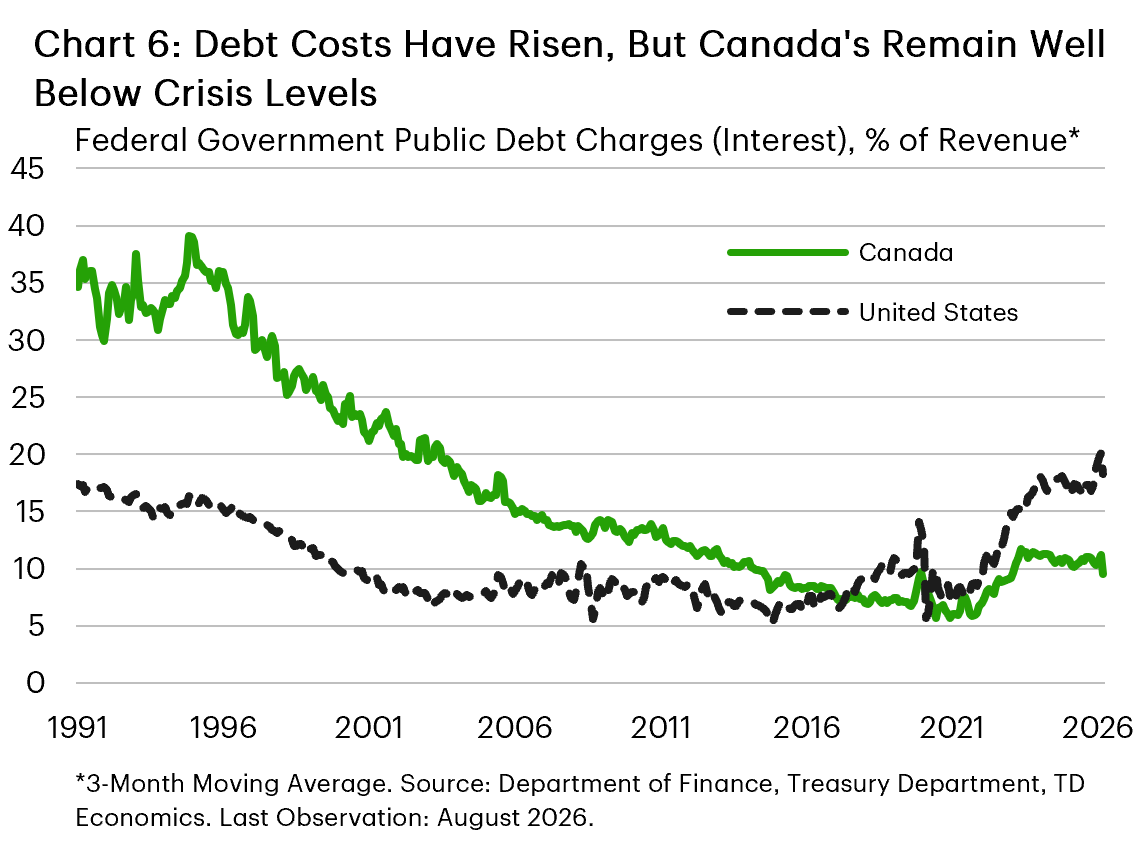 For Canada, the prospect of low economic growth and a large debt burden brings back uncomfortable memories of the fiscal challenges of the 1990s. During that time, public debt charges were consuming an astonishing 38.6% of government revenues. Large spending cuts, a return to economic growth, and a decade of persistently low interest rates have helped push down that burden to 10.4% (Chart 6).
But as a small open economy, Canadian government debt does not enjoy the privilege of its American counterpart. Borrowing costs depend, partly, on market perceptions of fiscal prudence (or folly) and events in U.S. financial markets. Canada quickly imports tighter financial conditions. This imparts greater importance on ensuring market credibility when it comes to fiscal sustainability. And unlike the U.S., Canada has limited room to raise tax revenues (34% of GDP, Chart 4), in the current bid to preserve competitiveness.
Fiscal sustainability may also face more scrutiny when the central bank is trying to fend off an inflation shock. Like the U.S., time matters on high energy prices. The yield curve has risen sharply in reaction to markets pulling forward expectations for rate hikes – highlighting there’s sensitivity to any new development that could impact government borrowing costs. For instance, seemingly benign remarks by Governor Macklem, on a Saturday, in a foreign country had consequential impacts on market pricing. Expectations for a quarter-point rate hike have risen above 80% for October 28th following negligible odds just one business day prior. What gives? Macklem expressed to media the question everyone is asking, “Is inflation likely to come back down towards our target on its own, or are we going to have to raise interest rates to influence the path… ?” The BoC must weigh this against the reality that a resilient Canadian economy is not out of the woods – evidenced by a job market averaging -12K positions on a three-month basis, new tariffs in August, and persistent trade uncertainty.
The bottom line, although borrowing costs are not always the product of government fiscal decisions, even slight slippage can be penalized depending on the sentiment-of-the-day. The global economy is dealing with two realities, rising fiscal pressures and high inflationary risks. We can already see that France is the cautionary tale for all countries on the former. Large fiscal outlays require politically challenging trade-offs for policymakers, at a time when inflation risks are not fully tamed. Others would do well to avoid it. So far so good for the U.S., with the rise in interest rates predominantly driven by the uncertainty of the energy shock and the hawkish messaging from central bankers. But this period too shall pass. And when it does, governments will still be left to deal with the fiscal backdrop. Managing the books prudently today could help ensure that tomorrow brings (interest rate) relief.
Disclaimer
This report is provided by TD Economics. It is for informational and educational purposes only as of the date of writing, and may not be appropriate for other purposes. The views and opinions expressed may change at any time based on market or other conditions and may not come to pass. This material is not intended to be relied upon as investment advice or recommendations, does not constitute a solicitation to buy or sell securities and should not be considered specific legal, investment or tax advice. The report does not provide material information about the business and affairs of TD Bank Group and the members of TD Economics are not spokespersons for TD Bank Group with respect to its business and affairs. The information contained in this report has been drawn from sources believed to be reliable, but is not guaranteed to be accurate or complete. This report contains economic analysis and views, including about future economic and financial markets performance. These are based on certain assumptions and other factors, and are subject to inherent risks and uncertainties. The actual outcome may be materially different. The Toronto-Dominion Bank and its affiliates and related entities that comprise the TD Bank Group are not liable for any errors or omissions in the information, analysis or views contained in this report, or for any loss or damage suffered.