Oil Markets Have Bought Time,
Not Insurance
Marc Ercolao, Economist | 416-983-0686
Date Published: August 4, 2026
- Category:
- Canada Commodities & Industry
Highlights
- Oil prices remain hostage to geopolitics as markets continue to swing between de-escalation hopes and renewed shipping disruptions.
- The oil market has leaned on several mechanisms to absorb the shock. Key buffers like inventory drawdowns, strategic reserves, rerouted flows, and softer demand have cushioned supply losses, leaving less room to respond to future disruptions.
- Recent events are unfolding largely in line with our June outlook. Near-term risks to oil remain skewed to the upside, but we expect oil prices to moderate in Q4 and through 2027 as markets gradually rebalance.
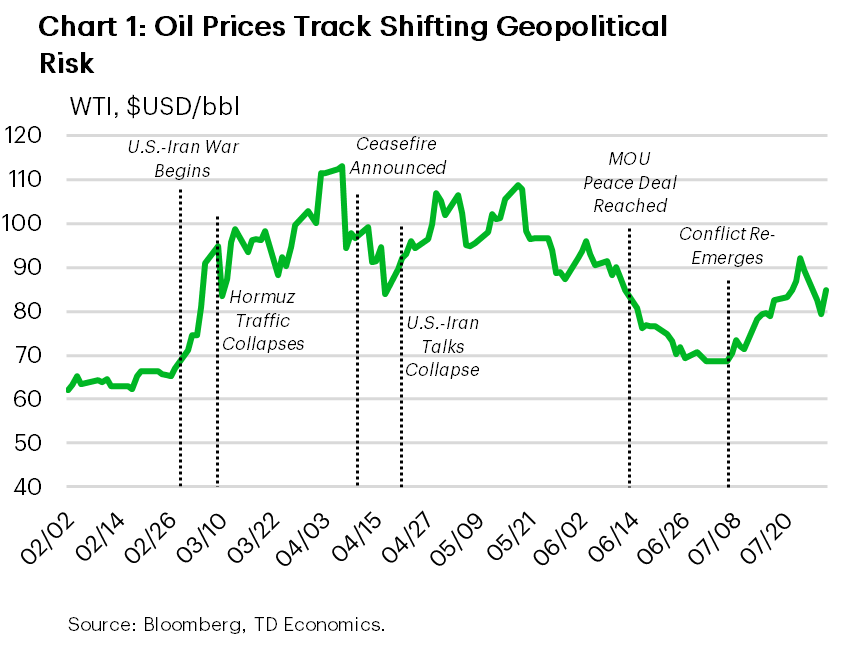
In recent weeks, oil markets have struggled to settle on a narrative. Following the U.S.-Iran peace deal and ceasefire agreement in mid-June, WTI crude fell from roughly $85/bbl to its pre-war level of below $70/bbl, as the conflict risk premium largely evaporated. By mid-July, attacks on shipping vessels in the Strait of Hormuz and Red Sea had challenged the peace deal framework and pushed prices back to above $90/bbl. At the time of writing, prices have settled between $80-85/bbl (Chart 1).
Recent conflict flare-ups underscore how quickly geopolitical risks can re-emerge and how rapidly markets can reprice risk. Together, the Strait of Hormuz and Bab el-Mandeb handle nearly 30 million barrels per day (bpd) of crude and refined product flows, equivalent to over one-quarter of global oil consumption. Hormuz carries approximately 20 million/bpd, while another 8-9 million/bpd transits the Bab el-Mandeb corridor between the Red Sea and Indian Ocean. Historically, the Red Sea route has acted as a partial pressure valve during periods of heightened Hormuz risk, allowing some Gulf producers, particularly Saudi Arabia, to redirect crude exports westward. But that safety valve becomes less effective when security concerns emerge at both chokepoints simultaneously. Where things go from here remains highly uncertain. But in this environment, markets are assessing how much more disruption they can realistically absorb if tensions escalate further.
Markets Have Adjusted, But the Margin for Error is Slimming
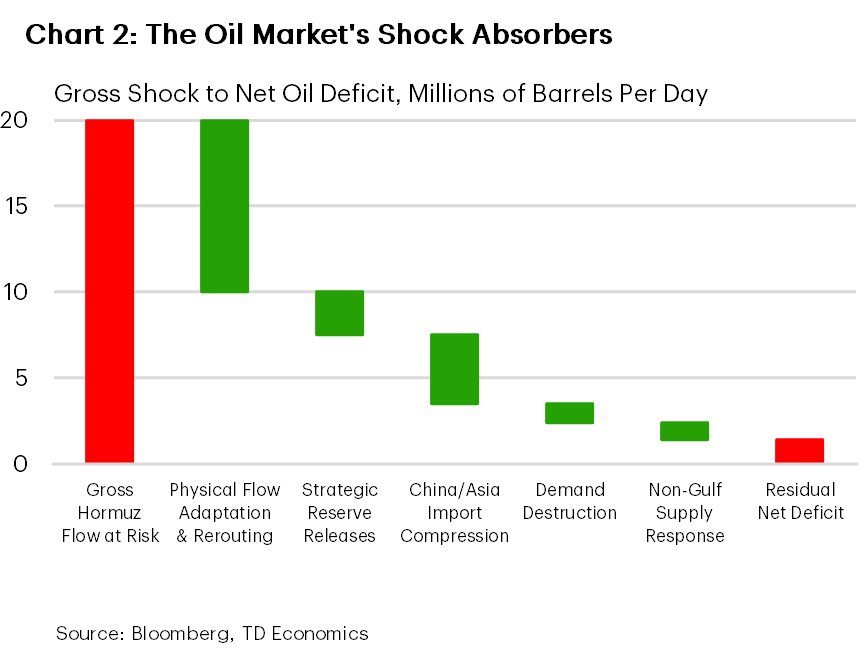
Abstracting from the recent price gyrations, the overall impact on energy markets from the supply shock has been more contained than many analysts would have expected. This can be chalked up to various adjustment mechanisms that have been working under the surface. Barrels have been rerouted where possible, strategic reserves have been released in massive quantities, inventories have been drawn down rapidly, buyers in Asia have reduced imports or leaned on stockpiles, and higher prices have encouraged some demand restraint (Chart 2). That resilience comes with an important caveat moving forward, in that many of the shock absorbers that helped stabilize the market are temporary or exhaustible.
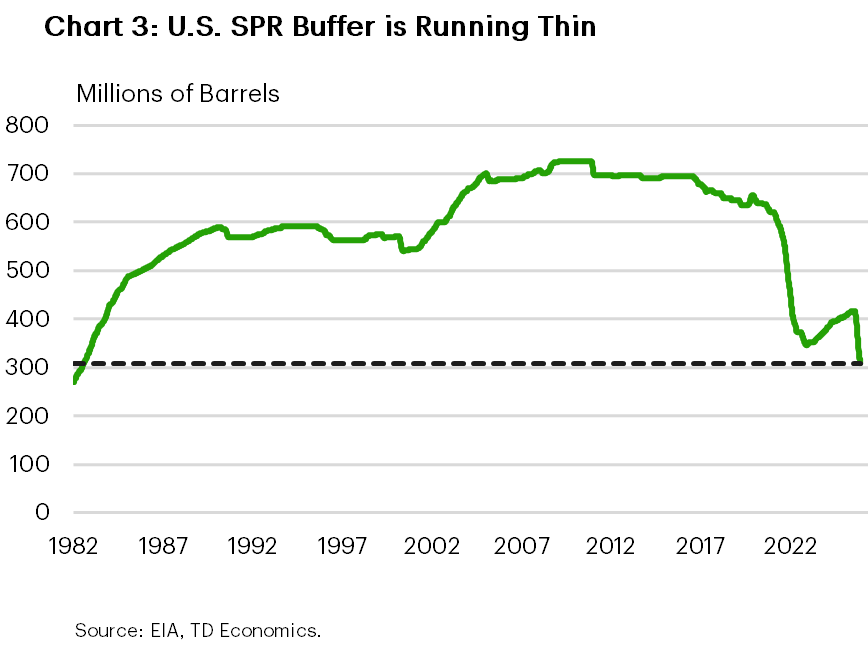
For one, strategic reserves and commercial inventories cannot be drawn down forever. The U.S. Strategic Petroleum Reserve (SPR) currently stands at roughly 310 million barrels, down from approximately 700 million barrels prior to the 2022 release program and at its lowest level since 1983 (Chart 3). Similarly, OECD petroleum inventories remain materially below pre-pandemic norms, while global inventories have continued to decline throughout 2026 as supply has struggled to keep pace with demand. Strategic releases and inventory drawdowns helped to cushion earlier shocks, but they leave the market with less flexibility the longer disruptions last.
Product markets are sending a similar warning. Even with refineries running near full tilt, U.S. refined product inventories remain lean, with gasoline stocks roughly 7% below their five-year average and distillate inventories about 10% below. That matters because the inflation risk from oil shocks is often felt most directly through refined products, especially diesel, where tight inventories and elevated crack spreads can keep pump and freight costs sticky even if crude prices ease. In other words, the market’s buffer problem is not just about crude barrels, but also about the availability of finished fuels.
At the same time, crude barrels were rerouted toward the Red Sea and Asian refiners sourced more crude from the Atlantic Basin. Saudi Arabia alone redirected roughly 5-7 million/bpd of crude flows through its East-West pipeline and Red Sea export system, helping keep supplies moving despite severe disruptions in Hormuz. But those alternatives may become less effective when security concerns emerge across both the Persian Gulf and Red Sea corridors.
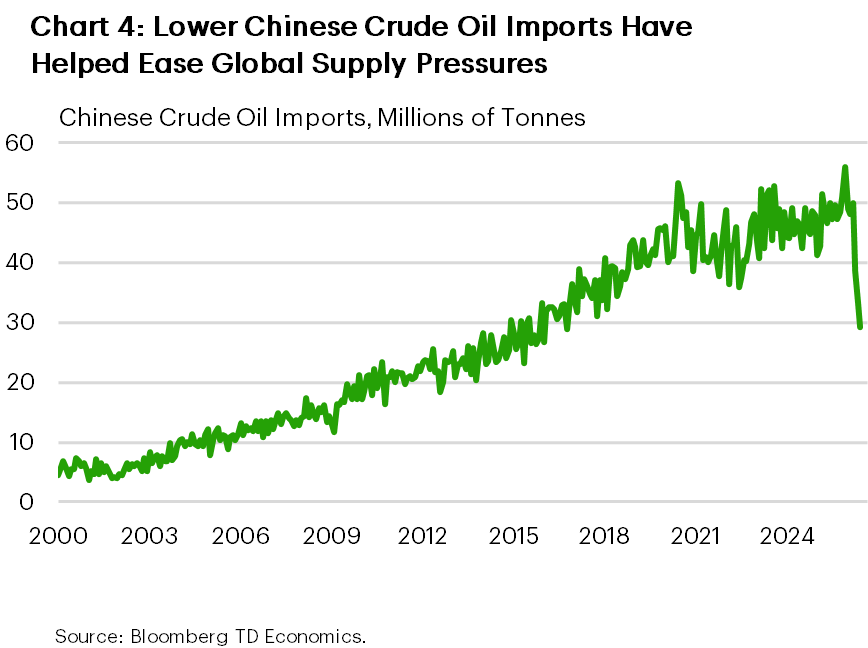
Taken together, the market's margin for error has narrowed considerably. The lesson is not that Hormuz or Bab el-Mandeb disruptions are inconsequential. Rather, it is that buffers bought the global economy time. Any future shock (or a prolonged current shock) will be more difficult to absorb and more visible in prices, inflation, and growth.
Forecast Implications
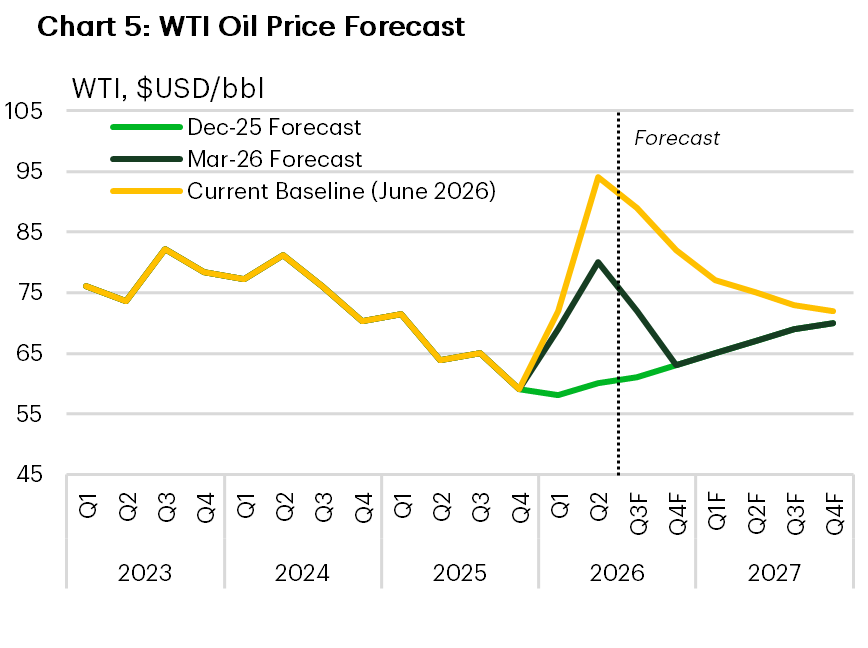
Recent developments are broadly consistent with our June outlook. At the time, we anticipated that oil markets would remain tight through the third quarter as many of the market's safeguards began to fade. So far in Q3-26, WTI prices are currently tracking close to our price target of $89/bbl on average. We remain comfortable with our existing outlook given the re-emergence of shipping risks and the market's reduced ability to absorb ongoing disruptions.
Looking ahead, our base case continues to assume that the U.S. and Iran ultimately refocus on diplomatic negotiations, allowing oil flows and tanker traffic through the Gulf region to gradually recover. As inventories stop drawing aggressively and supply normalizes, we expect prices to land in the low $80s/bbl by year-end before decelerating further into the $70s/bbl range in 2027 (Chart 5). Full market normalization will likely extend well into next year, as inventory rebuilding, insurance costs, and shipping logistics lag any political agreements reached today.
Forecasting oil prices in this environment remains exceptionally difficult, and risks remain two-sided. Weaker global growth or stronger-than-expected non-OPEC supply could place additional downward pressure on prices relative to our baseline. On the other hand, any renewed disruption to shipping lanes or Gulf production would likely have an outsized impact in the current market. On balance, we see risks slightly skewed to the upside in the coming months.
Disclaimer
This report is provided by TD Economics. It is for informational and educational purposes only as of the date of writing, and may not be appropriate for other purposes. The views and opinions expressed may change at any time based on market or other conditions and may not come to pass. This material is not intended to be relied upon as investment advice or recommendations, does not constitute a solicitation to buy or sell securities and should not be considered specific legal, investment or tax advice. The report does not provide material information about the business and affairs of TD Bank Group and the members of TD Economics are not spokespersons for TD Bank Group with respect to its business and affairs. The information contained in this report has been drawn from sources believed to be reliable, but is not guaranteed to be accurate or complete. This report contains economic analysis and views, including about future economic and financial markets performance. These are based on certain assumptions and other factors, and are subject to inherent risks and uncertainties. The actual outcome may be materially different. The Toronto-Dominion Bank and its affiliates and related entities that comprise the TD Bank Group are not liable for any errors or omissions in the information, analysis or views contained in this report, or for any loss or damage suffered.
Download
Share: