Labour Mobility Progress Is Real, But Canada’s Work Is Not Done
Rishi Sondhi, Economist | 416-983-8806
Date Published: September 2, 2026
Highlights
- Canada has made significant progress in reducing interprovincial labour mobility barriers through initiatives such as the Red Seal program and CFTA, making it easier for qualified workers to move across provincial borders.
- Despite these gains, roughly one-quarter of Canadian businesses reported difficulties hiring workers from other provinces because of licensing and certification requirements, with approval times remaining a key obstacle.
- The stakes are particularly high in healthcare and construction, where demographic pressures, retirements, and growing labour demand are expected to intensify worker shortages over the coming decade.
- Additional progress will require governments to further streamline applications, harmonize occupational standards, and build on reforms such as Ontario’s as-of-right certification model, which allows many workers to begin working while registration is finalized.
Canada has made meaningful progress in reducing interprovincial labour barriers. Early initiatives such as the Red Seal program helped establish common occupational standards across skilled trades, allowing certified tradespeople to work across Canada with fewer regulatory hurdles. The 1995 Agreement on Internal Trade (AIT) represented another important step, while subsequent initiatives such as the Canadian Free Trade Agreement (CFTA), introduced in 2017, increased transparency around exceptions on internal trade obligations and embedded the topic of labour mobility within a broader, more comprehensive agreement. More recently, governments have taken steps to ease labour mobility barriers. For example, the federal Free Trade and Labour Mobility in Canada Act (FTLMCA) received Royal Assent in June 2025. It reduces interprovincial barriers for workers under federal jurisdiction. In addition, notable measures have been taken in places like Nova Scotia, the Prairies and Ontario.
The next stage of reform is less about establishing the principle of labour mobility and more about making it work in practice. Certification and licensing requirements, administrative delays, differing provincial rules, and remaining exceptions continue to limit the ability of workers to move quickly across provincial borders. These barriers are especially important in sectors such as healthcare and construction, where labour shortages are likely to persist and where delays in moving qualified workers can carry broader economic costs.
Recent federal and provincial initiatives point in the right direction. But to unlock more of the economic benefit, governments will need to focus on the barriers employers and workers still encounter on the ground, especially in occupations where mobility could help ease capacity constraints and support Canada’s long-term growth agenda.
We released a report last week that highlighted the potential for a longer-term investment super-cycle in Canada if governments move boldly on improving the country’s competitiveness. Successfully addressing interprovincial trade barriers would push in the right direction on that front.
From Recognition to Real Mobility
While progress has been made in reducing formal barriers to labour mobility, employers continue to report challenges hiring workers from other provinces. In a 2023 Statistics Canada survey, roughly one-quarter of businesses reported difficulties hiring workers from other provinces because of certification or licensing issues (Chart 1). Employers also identified the time required for candidates to become certified or licensed, the cost of hiring out-of-province workers, and the effort needed to verify credentials as major obstacles (Chart 2).
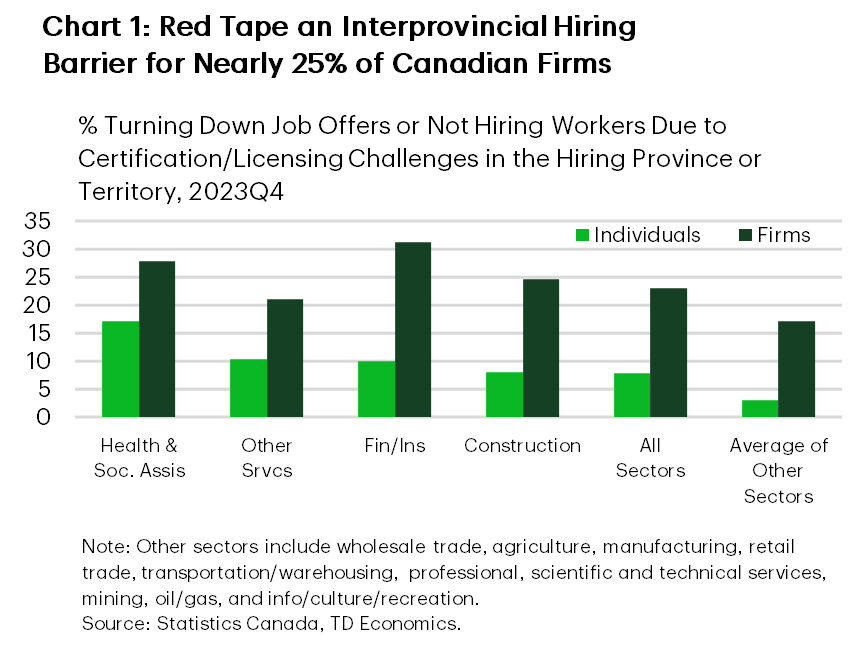
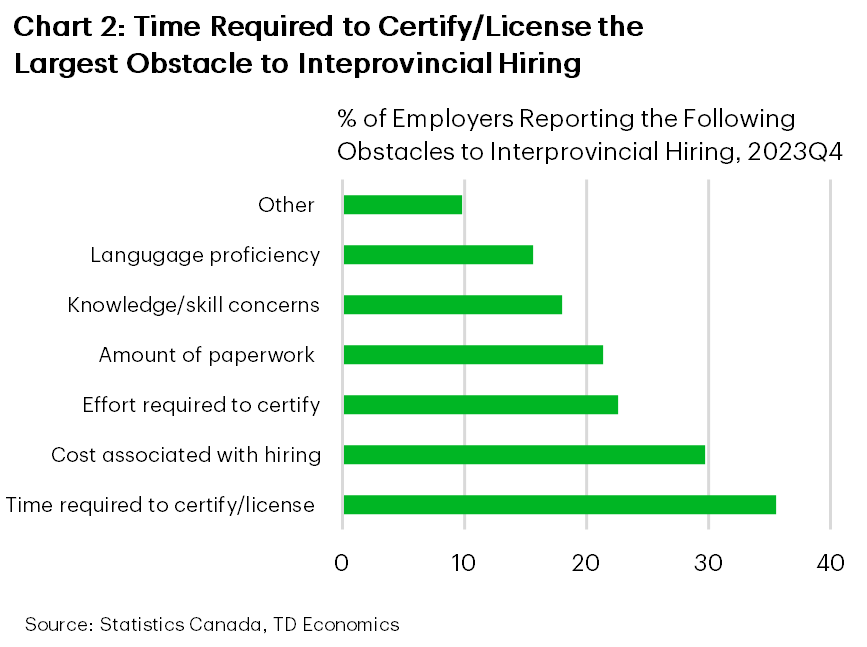
These findings suggest that the remaining labour-mobility challenge is increasingly administrative rather than legal. Workers may be eligible to practice in another province, but employers can still face delays and uncertainty before those workers are able to begin employment.
Governments have responded with a new wave of labour mobility reforms. Alongside the federal FTLMCA, Nova Scotia’s Free Trade and Mobility Within Canada Act and Prince Edward Island’s Interprovincial Trade and Mobility Act are designed to improve recognition of workers and businesses from other Canadian jurisdictions. These reforms point in the right direction, but their economic value will depend on whether they reduce the delays, costs, and administrative burdens employers and workers continue to encounter on the ground.
Where Mobility Barriers Matter Most
The economic case for further reform is strongest where labour shortages are persistent and the cost of delay is highest. When employers have vacancies and qualified workers are available elsewhere in the country, regulatory barriers that slow mobility can prevent skills from moving to where they are needed most. Removing these frictions can support a more flexible and productive economy. Indeed, several studies have highlighted the potential productivity gains from reducing internal trade barriers.1
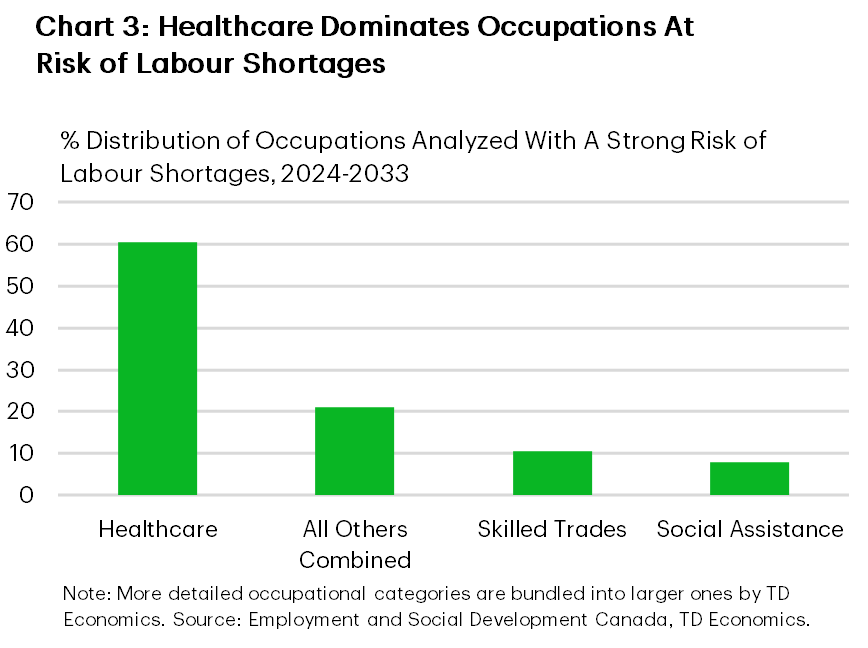
Healthcare stands to benefit considerably. Canada’s aging population is expected to increase demand for healthcare services while simultaneously raising retirement rates of healthcare workers. Labour market projections consistently identify healthcare occupations as among those most likely to face labour shortages in the coming years (Chart 3). Yet, healthcare employers were among the most likely to report difficulties hiring workers from other provinces because of licensing and certification requirements. The consequences extend beyond hiring challenges. Burnout among physicians remains well above pre-pandemic levels, leading some to reduce their hours or leave the profession altogether.2
Even with CFTA recognition, licensed healthcare professionals must apply to the provincial regulator and may still need to submit documents, pay fees, wait for approval, and complete background checks covering professional conduct, criminal records, and credentials. For nurse practitioners (for example), these steps can take as long as three months in some jurisdictions.3 Some nurses also face different provincial scope-of-practice rules after their credentials are recognized, requiring further education.4
Construction is another sector where lower labour mobility barriers could yield significant benefits. Canada’s construction industry faces substantial retirements over the coming decade alongside strong demand for workers, creating potential shortages.5 Red Seal and CFTA provisions have significantly improved mobility for many tradespeople, but important barriers remain.
Workers or contractors moving between provinces may also encounter different occupational health and safety training requirements, licensing rules, workers’ compensation registration systems, and municipal permitting requirements.6 Quebec’s construction sector, for example, operates under a distinct regulatory framework. As a result, a certified tradesperson may have their credential recognized and still face additional training requirements before beginning work.7
These barriers carry broader economic consequences. With Canada’s growth agenda hinging on housing, infrastructure, energy, and other major capital investments, reducing barriers that keep construction workers from moving to where they are needed most should be part of any serious strategy to expand capacity.
Targeting the Barriers That Still Slow Mobility
Reducing regulatory barriers will not, on its own, eliminate every obstacle to labour mobility. Geography, housing costs, employment opportunities, personal circumstances, and social ties all shape whether people relocate. These constraints underscore the importance of addressing the barriers governments can control.
One priority is to continue harmonizing occupational standards and certification processes across provinces. The Red Seal model shows that common standards can facilitate mobility while preserving professional quality. Extending harmonization to other occupations could further reduce administrative complexity.
Governments should also review and eliminate remaining CFTA exceptions where appropriate, collect data, and report regularly on interprovincial trade in labour, goods, and services.
Another priority is reducing licensing and certification delays. Lengthy processing times can affect employers’ ability to fill vacancies and workers’ ability to pursue opportunities in other provinces.
Several provinces have made notable progress by legislating maximum timelines for application reviews. However, Ontario’s as-of-right certification framework goes a step further in addressing this core issue. Traditional certificate-to-certificate recognition systems still generally require applicants to wait for formal approval before working. Ontario allows many workers licensed elsewhere in Canada to begin working while registration is finalized, directly addressing the obstacle employers report most often: waiting for workers to become licensed or certified.
Bottom Line
Canada has come a long way in reducing interprovincial labour mobility barriers. The remaining challenge is ensuring that workers who are already qualified can move efficiently to where their skills are needed.
The economic payoff from further reform is likely to be greatest in sectors facing persistent labour shortages, particularly healthcare and construction. Reducing licensing delays, harmonizing requirements, removing remaining exceptions, and expanding approaches such as Ontario’s as-of-right certification framework would help employers access talent more quickly and improve the allocation of labour across the country.
Regulatory reform cannot remove every barrier to mobility, but allowing workers to move more freely across provincial borders would support a more productive and resilient economy as Canada’s population ages and its investment needs grow.
End Notes
- Tombe, T., & Schwanen, D. (2020, September). Alberta’s opportunity: The ins, outs and benefits of greater job mobility (Commentary No. 580). C.D. Howe Institute. https://www.cdhowe.org
- Canadian Medical Association. (2025, October 14). Five years since onset of COVID-19, Canada’s physicians still suffer high rate of burnout. https://www.cma.ca/about-us/what-we-do/press-room/five-years-onset-covid-19-canadas-physicians-still-suffer-high-rate-burnout.
- Augury Healthcare Compliance Team. (2025, November). Credential transfer between provinces: What you need to know. Augury Healthcare. https://auguryhealth.ca/resources/credential-transfer-between-provinces.
- Ibid.
- BuildForce Canada. (2026). Construction and maintenance looking forward: National forecast 2026-2035, non-residential construction. BuildForce Canada. https://www.buildforce.ca/wp-content/uploads/2026/07/Construction-Maintenance-Looking-Forward-2026-2035-non-residential.pdf
- Canadian Federation of Independent Business. (2026). 2026 interprovincial trade report card. https://www.cfib-fcei.ca/hubfs/research/reports/2026/2026%20Interprovincial%20Trade%20Report%20Card-EN.pdf
- Ibid.
Disclaimer
This report is provided by TD Economics. It is for informational and educational purposes only as of the date of writing, and may not be appropriate for other purposes. The views and opinions expressed may change at any time based on market or other conditions and may not come to pass. This material is not intended to be relied upon as investment advice or recommendations, does not constitute a solicitation to buy or sell securities and should not be considered specific legal, investment or tax advice. The report does not provide material information about the business and affairs of TD Bank Group and the members of TD Economics are not spokespersons for TD Bank Group with respect to its business and affairs. The information contained in this report has been drawn from sources believed to be reliable, but is not guaranteed to be accurate or complete. This report contains economic analysis and views, including about future economic and financial markets performance. These are based on certain assumptions and other factors, and are subject to inherent risks and uncertainties. The actual outcome may be materially different. The Toronto-Dominion Bank and its affiliates and related entities that comprise the TD Bank Group are not liable for any errors or omissions in the information, analysis or views contained in this report, or for any loss or damage suffered.
Download
Share: