Housing Affordability: The Bumpy Road to Recovery Hits a Hurdle
Rishi Sondhi, Economist | 416-983-8806
Date Published: November 26, 2026
- Category:
- Canada
- Real Estate
Highlights
- In resale markets, the improving trend in Canada’s housing affordability since 2023 has hit a speed bump. Affordability stalled in the second quarter and deteriorated in the third as borrowing costs moved higher.
- There’s more to the regional story than pricey Ontario and B.C. Across other provinces, Quebec, PEI and Nova Scotia are the most strained relative to their own histories, while affordability in Alberta, Saskatchewan and Newfoundland and Labrador remains much closer to historical norms.
- The current affordability setback should prove short-lived, with some relief likely as 2027 unfolds. But getting affordability back to a more normal setting will likely require a combination of forces coming together. Modestly lower longer-term borrowing costs and income gains should help, but lasting relief will require stronger housing supply alongside favourable price dynamics.
 Housing affordability has been one of the major challenges facing households in recent years. While some of the pressures that built up during the pandemic have eased, the path back to more normal conditions is proving neither quick nor uniform. In this report, we take stock of where affordability in Canada’s resale housing markets stands today, how the picture differs across the country, and what it might take to deliver more meaningful relief.
Rate Backdrop Reverses Affordability Improvements
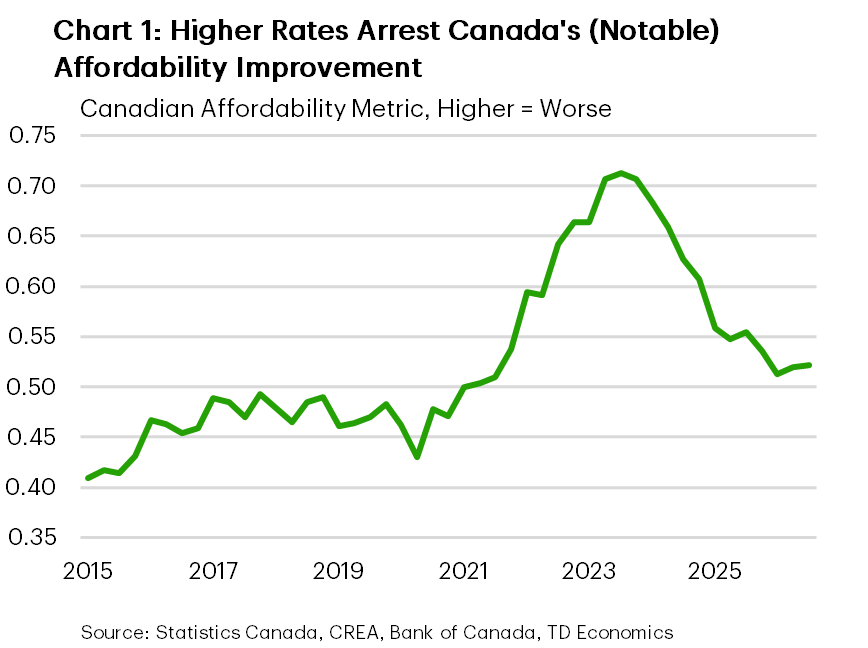
Canadian housing affordability1 had been on an improving track since 2023Q3 (Chart 1), driven by declining home prices in B.C. and Ontario, falling mortgage rates, and rising incomes coast-to-coast. Still, even with these improvements the situation is far from pristine. Affordability remains worse than historical norms, consistent with the early-to-mid-1990s when mortgage rates were in the double digits.
The recent backup in yields has also halted progress. Indeed, Canada-wide affordability deteriorated by 2% over the second and third quarters.
Some Surprises in the Regional Affordability Picture
 Ontario and B.C. tend to steal the national headlines on housing affordability, and for good reason, as the absolute level of affordability is the worst in these two regions. But the steep decline in home prices alongside rising wages have helped affordability return close to their pre-pandemic level in these two markets.
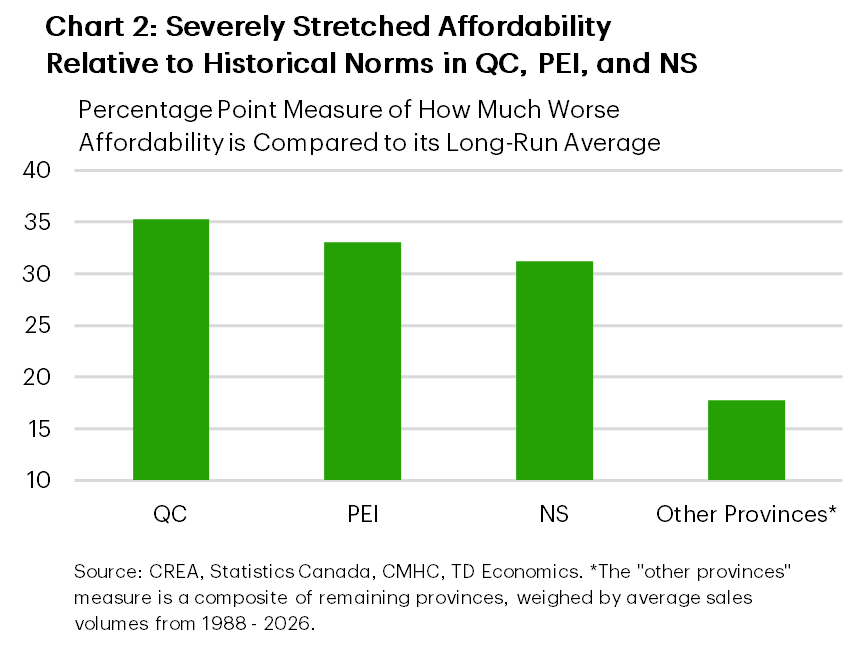
Looking elsewhere reveals some interesting trends. Relative to their own histories, our metrics tell us that ownership housing is the most unaffordable in Quebec, PEI and Nova Scotia (Chart 2)2. While this may surprise some, note that prices were between 60-80% above pre-pandemic levels in these markets in the third quarter of this year. Interestingly, New Brunswick has also recorded exceptionally robust price growth over this period. However, because affordability was so favourable before the pandemic, it has not deteriorated as sharply relative to its own history as it has elsewhere in the country.
Affordability is not that far off long-run averages in Alberta and Saskatchewan, underpinning the relatively firm 3-4% year-to-date price increases in these jurisdictions. While a multi-year run of robust employment growth in Alberta has lifted incomes, Saskatchewan hasn’t enjoyed the same labour market momentum. What has helped these provinces is their constructive starting point for prices. Recall that both provinces were reeling from the effects of oil price declines in 2014/15 and 2018/19. Home prices fell by 1% on average over that period. Newfoundland and Labrador similarly entered the pandemic from a solid affordability position and remains broadly in line with historical norms. In Manitoba, affordability is significantly worse relative to history, impacted by solid price growth and interest rates, and a weaker economic performance than most other provinces since the pandemic.
Interest Rates Won’t Affect All Provinces Equally
It’s a well-worn story that, in absolute terms, affordability is the worst in B.C. and Ontario, with the average household paying between an estimated $3,500-$4,100 in monthly mortgage payments3. This compares with about $1,500 in Saskatchewan and New Brunswick. However, a 10-bp rise in interest rates from their current level would drive an increase in mortgage payments in B.C. that’s two to three times larger than every other province outside of Ontario. Similarly, the same interest rate bump in Ontario would yield a rise in payments 1.5 to two times as large as other provinces. Suffice it to say, incomes in B.C. and Ontario are not outpacing the rest of Canada to the same degree.
Stretched Moving Forward
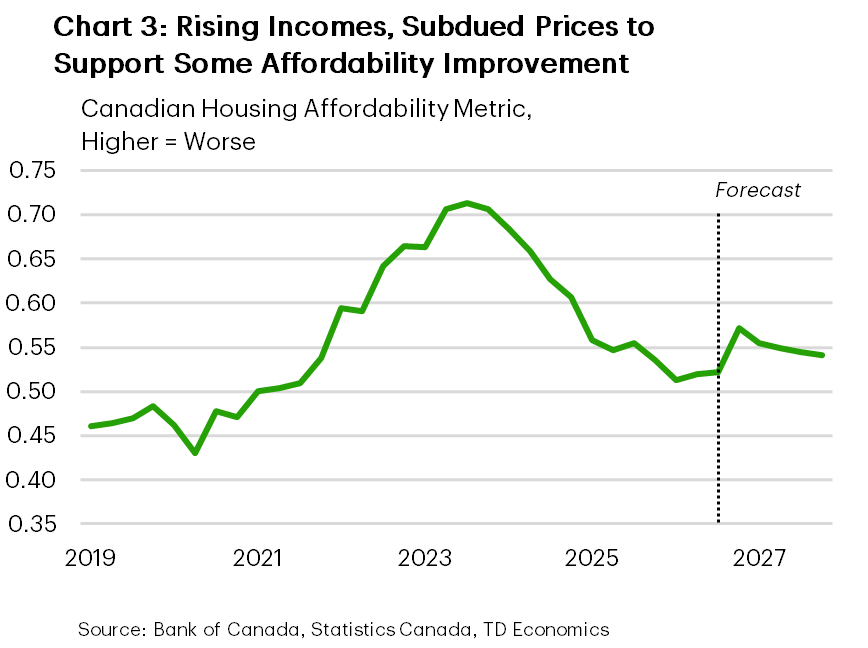
We’re anticipating some easing in affordability pressures over the next year. Indeed, we’re estimating a 5% improvement nationwide by the end of 2027 (Chart 3). Continued household income growth is expected to do most of the work in putting affordability back on an improving track. Another year of (what should be) subdued price increases will also help. We’re also anticipating some decline in bond yields across the curve. Across provinces, affordability is likely to see the most relief in Ontario, B.C. and Alberta. Price growth will likely be relatively modest in the former two provinces, while comparatively firm economic activity should lift incomes in Alberta.
In the short-term, complicating this improving rate dynamic is the likelihood that the Bank of Canada will follow up its October rate hike with one additional move to mitigate against upside inflation risk. This tightening – alongside falling oil prices – is expected to bring headline inflation towards target next year.
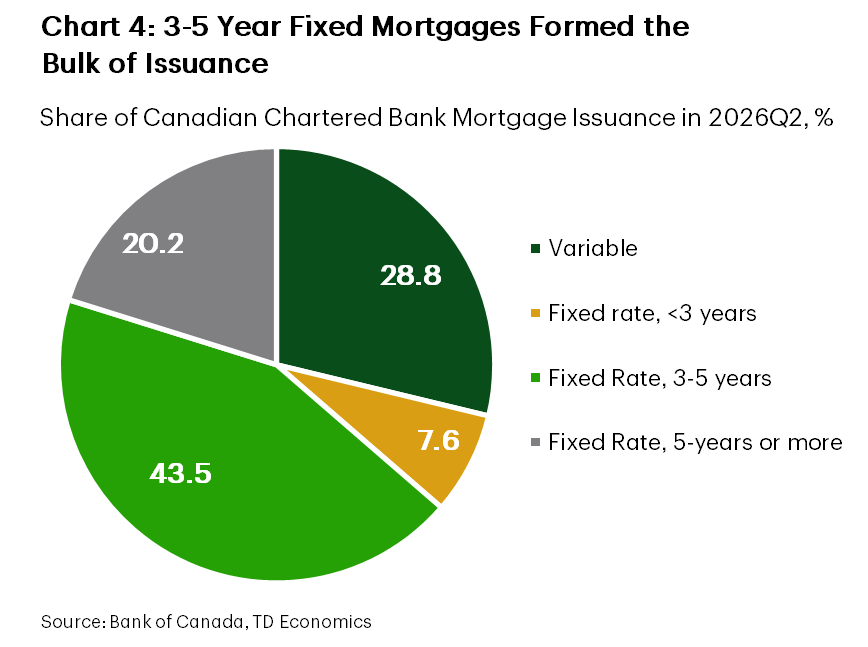
The expected further interest rate increase would upwardly pressure variable-rate mortgages and this is notable because these products have become an increasingly important part of the mortgage universe. Indeed, according to Bank of Canada data, some 30% of new mortgages issued by Canadian banks were variable in the second quarter, up from about 5% in the middle of 2023 and a long-term average of about 23% (Chart 4). However, fixed-rate mortgages with terms between three to five years now account for the largest new mortgage issuance (about 45% in 2026Q2). Meanwhile, mortgages with terms of five years or more have fallen somewhat out of favour, accounting for 20% of issuance, compared to 65% in 2019.
Unfortunately, the improvements that do manifest will likely do little to change the narrative that affordability is challenging across much of Canada. This is partly because markets will be starting from a tough position. In addition, bond yields, while trending slightly lower, are likely to remain relatively elevated. What’s more, income growth should be constrained by an only gradual amelioration in labour markets.
Still-strained affordability is a key factor underpinning our outlook for modest price gains, at best, in most provinces in 2027. Price growth is likely to be firmer in Alberta, Saskatchewan and Newfoundland and Labrador, reflecting affordability that remains within historical ranges.
Stressing our Baseline
While we think it’s overdone, markets are pricing in about 2.5 additional 25 bp Bank of Canada rate hikes by October of next year. Taking the market’s expectation on board suggests that Canadian housing affordability could be about 2% worse next year than our baseline view, with some offset coming from the fact that prices would also be lower.
If interest rates were lower than anticipated, affordability would improve by more than projected, although it would likely remain strained. Perhaps the more interesting question is how affordability could return to a less-challenging level (like its pre-pandemic level, for example) over time. Holding other factors constant, this would require prices to fall by around 10%, incomes to increase by roughly the same amount, or interest rates to fall by about 80 bps. However, we are not holding other factors constant and, in fact, expect price growth to eventually strengthen while interest rates remain elevated.
 Because neither lower rates nor stronger incomes are likely to close the affordability gap on their own, additional housing supply will likely be needed. Our prior research suggested that a rate of 400k new housing completions annually could do the trick, given our assumptions around an eventual firming in both economic growth and home price gains. Because affordability pressures have eased by more than we expected back then, achieving that run rate for completions would more rapidly return affordability to its pre-pandemic level. However, completions are likely to fall well short of that level over the next couple of years. More realistically, it would take a combination of income gains and/or subdued price growth alongside some ramp-up in housing supply to generate further sustained and notable improvements in affordability. And if it does indeed materialize, it would likely be more of a medium-term story.
The tenure and type of housing built will also matter. Provinces where affordability is especially stretched relative to historical norms, including Manitoba, Quebec and much of Atlantic Canada, could benefit from a greater increase in ownership-oriented construction. Much of the recent homebuilding in these provinces has been concentrated in purpose-built rental units. While this should help ease pressure in rental markets, some rebalancing toward ownership supply may also be required to support affordability for prospective buyers.
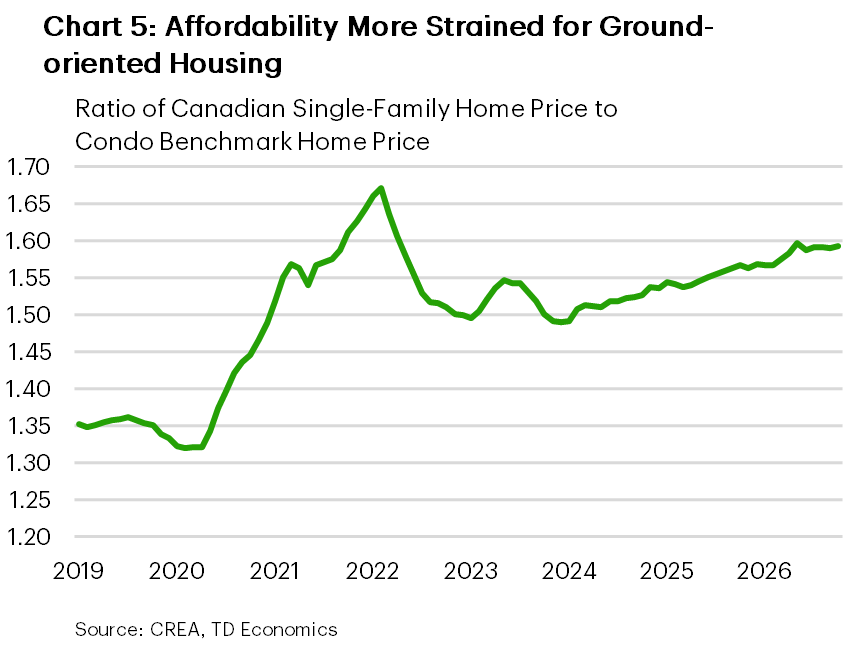
Within the ownership market, ground-oriented housing types could provide the greatest relief. The average monthly mortgage payment on a resale detached home in Canada is now about 60% higher than on a resale condominium, double the roughly 30% gap recorded before the pandemic (Chart 5). This widening partly reflects the sharp decline in resale condominium prices in Toronto and Vancouver, which dramatically improved national condo affordability for these units. Canada’s remaining resale ownership-affordability challenge is therefore increasingly concentrated in ground-oriented housing, including detached homes, semi-detached homes and townhouses.
Bottom Line
Canada’s resale housing affordability challenge remains widespread and has worsened recently amid the rise in borrowing costs. However, its contours vary considerably across the country. Although they’ve seen substantial improvements since 2023, Ontario and B.C. remain the most expensive markets in absolute terms. Meanwhile, Quebec and most of Atlantic Canada stand out as particularly stretched relative to their own histories.
There is no quick or painless route back to lasting relief in affordability, particularly with prices unlikely to deteriorate much further and interest rates set to remain elevated. The recent federal budget contained laudable initiatives to address homelessness, but much of the effort is concentrated on non-market housing. The federal government also recently exempted newly built homes from the foreign-buyer ban, but this should be demand-stimulative, on the margin.
A lasting improvement will likely require several factors working together, including stronger income growth and a sustained increase in housing supply. That points to a gradual, multi-year adjustment rather than a rapid return to historical norms.
Endnotes
- Affordability is calculated using data on mortgage interest rates and new issuance at terms of less than 1 year, 1-3 years, 3-5 years, and 5+ years. A 20% downpayment and 25-year amortization are also assumed, while average price data from the Canadian Real Estate Association is also used.
- For chart 2, a 5-year mortgage rate is used in the calculation (rather than the blended rate metric used in the rest of the paper) because it provides a longer data sample (1988-2026 vs 2013-2026 for the blended measure)
- These calculations assume the average home price in October 2026, Ratehub.ca’s prevailing “best five-year rate” at time of writing, a 25-year amortization and a 20% down payment.
Disclaimer
This report is provided by TD Economics. It is for informational and educational purposes only as of the date of writing, and may not be appropriate for other purposes. The views and opinions expressed may change at any time based on market or other conditions and may not come to pass. This material is not intended to be relied upon as investment advice or recommendations, does not constitute a solicitation to buy or sell securities and should not be considered specific legal, investment or tax advice. The report does not provide material information about the business and affairs of TD Bank Group and the members of TD Economics are not spokespersons for TD Bank Group with respect to its business and affairs. The information contained in this report has been drawn from sources believed to be reliable, but is not guaranteed to be accurate or complete. This report contains economic analysis and views, including about future economic and financial markets performance. These are based on certain assumptions and other factors, and are subject to inherent risks and uncertainties. The actual outcome may be materially different. The Toronto-Dominion Bank and its affiliates and related entities that comprise the TD Bank Group are not liable for any errors or omissions in the information, analysis or views contained in this report, or for any loss or damage suffered.
Download
Share: