Canadian Labour Market & Recession Risk in the Age of AI
Rannella Billy-Ochieng’, Senior Economist | rannella.billyochieng'@td.com
Date Published: June 4, 2026
Highlights
- Canada’s labour market adjusts slowly, which has historically cushioned it during downturns, but this stabilizing feature may become a vulnerability.
- AI adoption alone is unlikely to immediately threaten workers. Digital technology will change how work is performed, but employees will continue to play a key role in an AI-empowered world.
- Where we are in the business cycle matters. Recessions tend to catalyze strategic change inside firms. When weak demand intersects with rapid cost saving technological adoption, employers are more likely to redesign workflows and positions, increasing the risk that jobs lost in a downturn do not return in their prior form.
- When technology permanently displaces roles, policies should prioritize faster worker transitions through flexible, affordable retraining and human‑centric skill development, rather than job retention, which risks higher long‑term unemployment and worsened productivity scarring.
Canada’s labour market has softened, and our base case predicts modest job growth in the near term. In this period of slow economic growth, it’s important to consider the risks that could arise if a recession occurs. Understanding these risks can help policymakers proactively plan an effective response.
In past post-war downturns, Canada has experienced fewer job losses but slower recoveries than the United States. Canada has more shock absorbers, which cushion workers during recessions. That stabilizing feature, however, could become a vulnerability when a downturn coincides with permanent, labour-saving technologies, such as generative artificial intelligence (AI).
On its own, AI adoption may not pose an immediate threat to workers. In the near term, its impact is more likely to take the form of task transformation and role augmentation, particularly in occupations with high exposure to AI. However, when labour‑saving technologies are deployed under economic stress, re‑hiring patterns can change, raising the likelihood that jobs lost do not return in the same form. For displaced workers, this increases the risk of longer periods of joblessness and greater skills erosion.
When downturns coincide with permanent changes in how work is organized, the policy challenge shifts. Tools designed to cushion cyclical shocks by preserving existing job matches become less effective. In that setting, limiting long‑term scarring depends less on retention and more on facilitating faster transitions through flexible retraining in skills that complement AI, and supports that shorten periods of joblessness. The resilience of Canada’s labour market will increasingly depend on how smoothly workers can make these transitions.
Labour Market Adjustments Over History
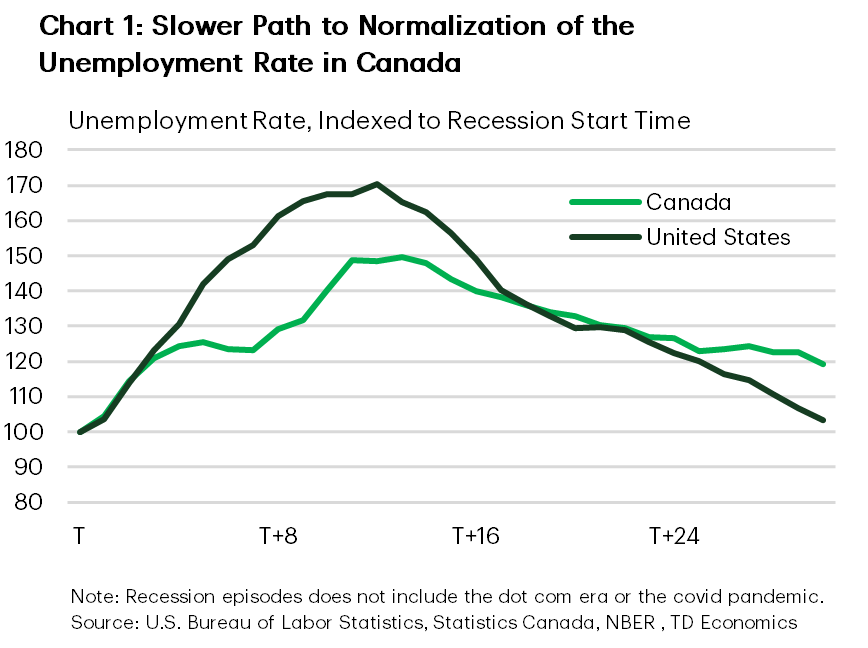
Historically, Canada’s labour market has reacted less sharply to recessions than the U.S. market. On average, the unemployment rate has risen less in Canada but also recovered more slowly (Chart 1). That relationship is visible in the relationship between economic output (real GDP) and unemployment.1 Holding the severity of the decline in GDP constant across the two countries, Canada’s labour market is less sensitive to economic downturns than that of the United States.
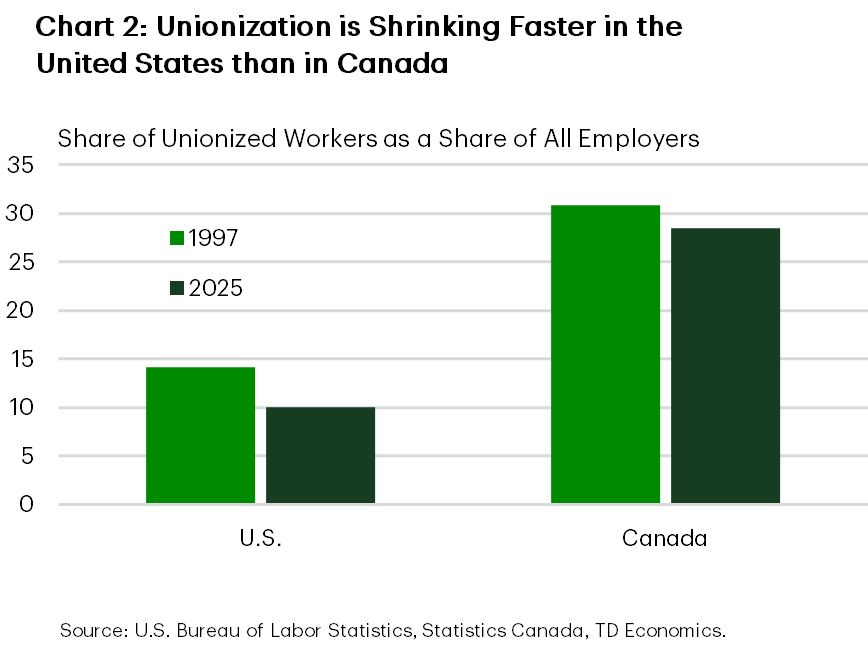
Canada’s institutions help explain this slower adjustment. Firms in the United States can adjust their workforce more quickly due to an at-will legal framework.2 Employment protections in Canada are stronger and workers benefit from uniform federal employment insurance. Moreover, Canada’s unionization rate is more than twice as large as the United States. The cross-border unionization gap has widened as the unionization rate has shrunk faster in the United States than in Canada (Chart 2).
These institutional features matter because the costs and benefits of slow labour-market adjustment depend on the nature of the shock. When downturns are followed by rehiring into largely unchanged roles, slower adjustment helps preserve job matches and limits hardship. However, when demand shifts away from specific tasks, such as when firms adopt labour-saving technologies, slower adjustment can delay reallocation toward expanding tasks and firms. International evidence shows that many routine jobs lost in recession do not return, contributing to “jobless” recoveries.3 In this setting, policies and institutions that slow job transitions risk prolonging unemployment.
Digital Technologies will Structurally Reshape Labour Markets
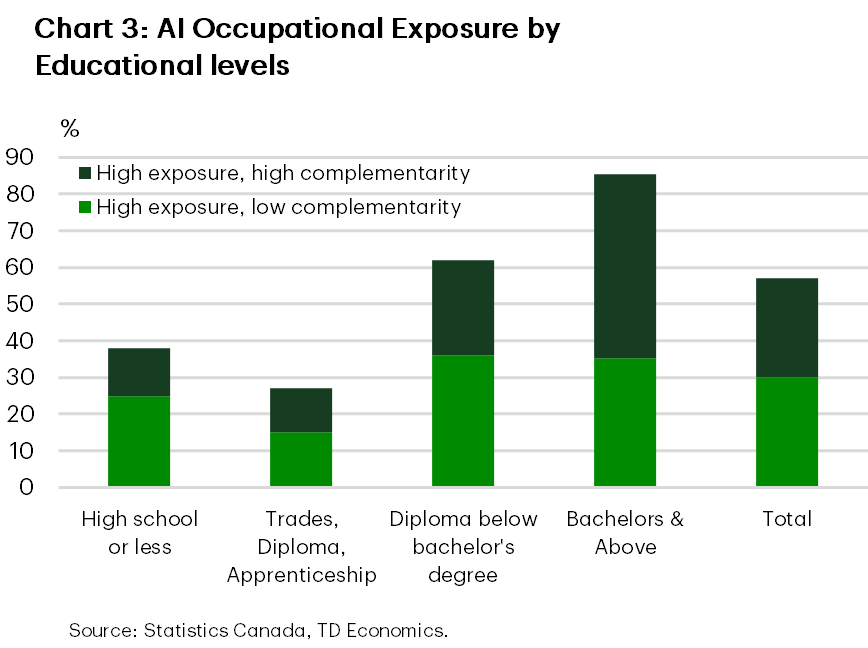
Canada’s labour market is entering a period where firms will reorganize how work gets done. This shift will affect most sectors of the economy. Statistics Canada estimates that close to 60 % of jobs in Canada have exposure to AI, and there is a high concentration in cognitive roles that are highly skilled and require university training (Chart 3).4
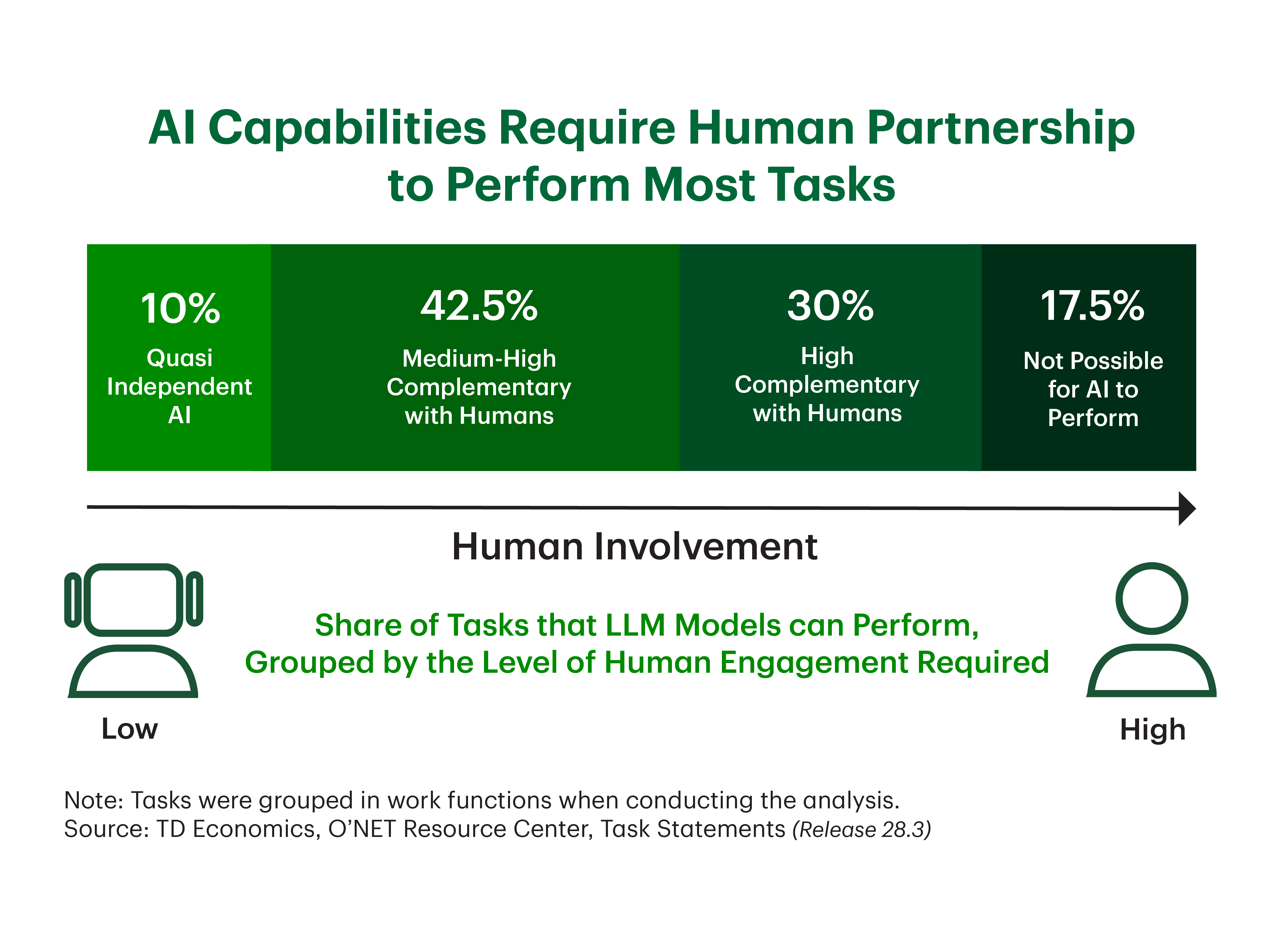
In the near term, AI is reshaping work by altering tasks within jobs rather than eliminating entire roles. Each job comprises many tasks, and most of those still require significant human judgment (see infographic). For now, AI is more likely to complement workers rather than replace them. As AI capabilities expand, firms are likely to reorganize how work is structured around this partnership. This is a structural change in how work is organized and not a temporary adjustment.
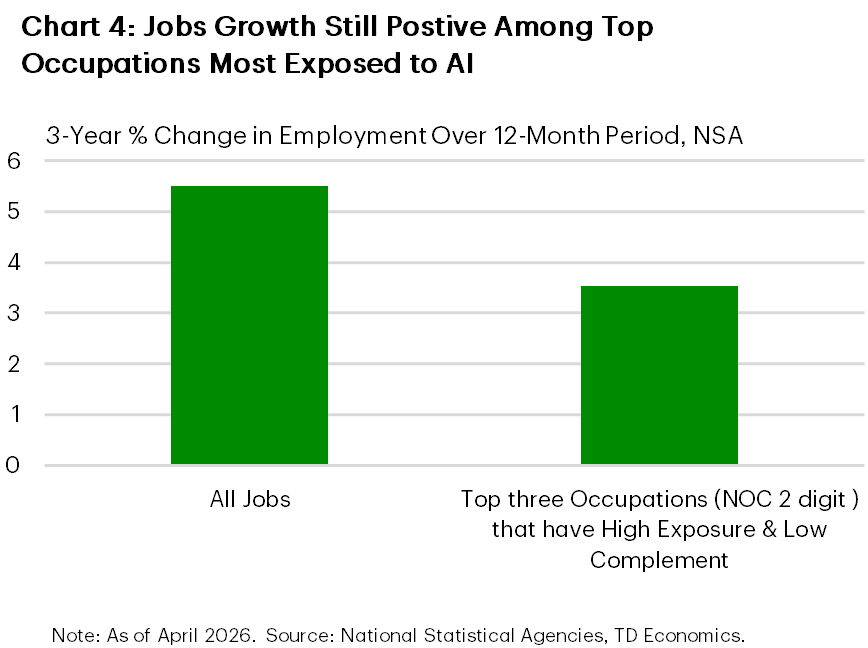
AI adoption on its own is unlikely to catalyze a recession in Canada. Even as some jobs are lost, the technology is generating demand for new tasks and spurring incremental investment, supporting productivity and income growth. Even in occupations with high AI exposure and low complementarity, job growth has remained positive (Chart 4).
Why Cyclical Downturns Can Accelerate Automation
Downturns do happen though. And when they do, they force firms to rethink how work gets done and can accelerate labour‑saving technological change by lowering the opportunity cost of reorganizing production. When demand is weak and survival pressures intensify, firms face less disruption from restructuring workflows and managerial focus shifts from growth to efficiency.
Evidence from U.S. online job vacancies during the Global Financial Crisis shows that firms in harder‑hit labour markets upgraded skill requirements and redesigned jobs in ways consistent with technology‑enabled restructuring rather than temporary retrenchment.5 Importantly, these changes persisted into the recovery, suggesting that recessions can act as catalysts for permanent task reallocation, not just pauses in hiring. This happens as businesses cut costs and improve efficiency to support their survival.
The digitization that occurred during the Covid era is another example of businesses adjusting rapidly to survive tight constraints. Companies were forced to rethink how they delivered goods and services, fueling innovation and automation. Efforts were led by traditionally low-productivity sectors that raised efficiency by doing more with less.
The Compounding Effect: AI Adoption During Downturns
Historical episodes of large scale labour displacement show that job losses tied to structural change do not always self correct as the economy improves. When workers are displaced from roles that no longer fit employers’ needs—such as during past manufacturing shocks—job losses can prove long lasting, particularly when skills become obsolete.
AI fits within a familiar pattern of labour saving technological change. However, unlike many past productivity gains that focused on physical or process based work, AI is most effective at performing routine cognitive and administrative tasks. In an economy increasingly dominated by services, this shifts adjustment pressure toward a broader range of white collar occupations.
This distinction matters most during downturns. When firms adopt AI under weak demand, they are less likely to have the same need for these roles once conditions improve. In this setting, downturns do more than pause hiring; they reshape it. As the economy recovers, new roles are created, but they tend to be concentrated in positions that complement the new technology. For displaced workers, this raises the risk that job losses persist, increasing the likelihood of longer jobless spells and skills erosion.
The Role of Education as a Recession Hedge
Technological change has generally favoured highly-skilled workers. An estimated 80% of the rise in the college wage premium is explained by automation, which induces task displacement.6
Higher education has also long been a buffer against job loss. Data from Employment and Social Development Canada (ESDC) shows that during the Global Financial Crisis, the unemployment rate for individuals who did not complete high school increased almost three times more than for those who had a university education.7 Their recovery was muted even three years after the shock. Among workers who lost their jobs, employees with a university degree had a five-percentage point higher chance of being rehired in the short run than those without university training.8
Workers with post-secondary educations have an advantage in an AI-enabled world, but that capability, needs to be met with greater reinforcement of skills and adaptability. Workers will need to be agile, teachable, and lean into human-centric skills (e.g. judgment intensive, social, and communication) to open doors when opportunities are scarce. The lion’s share of Canadian workers are college educated and are well placed to embrace this challenge. AI technologies have the potential to favour workers with these complementary skills. Data from the OECD shows that Canada leads the G7 in having AI talent concentration.9 That stock of human capital suggests that we have the right mix of talent to lean into the moment.
Policy Response to Support Dislocated Workers and Minimize Scarring
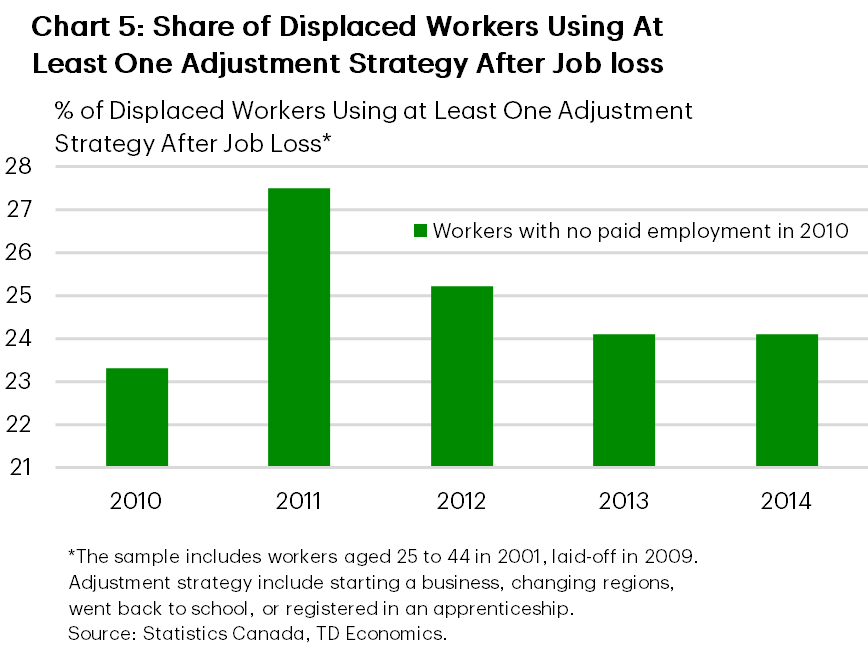
Canadian active labour market policies encourage displaced workers to retrain or upskill. But a Statistics Canada study that looked at how displaced workers responded to job loss showed that three out of four displaced worker who did not find employment in the year after job loss did not explore adjustment strategies (Chart 5).10 Ensuring that workers make use of retraining or upskilling is key.
This matters because evidence from recent downturns suggests that job retention tools and income support can unintentionally delay adjustment when the underlying shock is structural rather than cyclical. OECD assessments of COVID‑era policies caution that while wage subsidies and work‑sharing preserved employment relationships in the short run, they showed evidence of slowing worker movement away from shrinking tasks when maintained too long or applied too broadly.10 In other words, when technological change permanently reduces labour demand in certain roles, policies that prioritize retention over transition risk increasing long‑term unemployment and productivity scarring.
To help displaced workers get back on their feet, governments need to offer straightforward retraining paths that lead to the specific skills employers are hiring for. The medium of delivery for training also matters because many workers opt out of retraining opportunities because of financial, time, and family constraints. Crucially, workers who can pair tacit knowledge (e.g. experience & intuition) with formal codified knowledge (e.g. book learning) are better positioned to navigate displacements. Workers need to lean into critical human centric skills to open doors to more opportunities. Being human first is a distinct advantage.
Businesses also have a role to play in navigating this change. Building a culture of trust, transparency and engagement will help more workers lean into the moment and grow their skillset as technological capabilities expand.
Without adequate support many displaced workers will leave the labour force. Ultimately, that could reduce the benefits we can reap if all workers were meaningfully deploying their talent towards a more productive economy.
Conclusion
Canada’s long-standing ability to cushion labour market shocks may be less resilient in an environment where businesses are forced to make hard choices to survive. AI adoption alone may not pose an immediate risk to the Canadian workforce, but when cost saving technologies like AI collide with a downturn, firms may permanently change how work is done. As economic stress forces firms to make hard choices, some job losses may not reverse.
Canadians are well educated and can face this challenge head on and there is an opportunity for some workers to benefit from the moment. Policy supports needs to be precise to support reskilling dislocated workers and minimizing outflows from the job market. The stakes are high and acting early will help to limit long term labour market damage.
End Notes
- Okun’s Law originates from the work of Arthur Okun, it is a simple empirical rule that quantifies how shortfalls in economic output translate into higher unemployment during business cycles.
- At will employment-under this arrangement means an employee may quit at any time, and the employer may fire an employee for any reason and at any time, except unlawful reasons. All states except Montana allows for at will employment, providing the reasons do not include illegal discrimination (based on race, sex, age (40+), disability, genetic information, reporting unsafe workplace practices, refusing to conduct illegal activities) https://www.usa.gov/termination-for-employers. https://www.law.cornell.edu/wex/at-will_employment Source from: Cornell University and USA Government.
- Job Polarization And Jobless Recoveries, NBER Working Paper No. 18334; Review of Economics and Statistics (2020) https://www.nber.org/system/files/working_papers/w18334/w18334.pdf
- Statistics Canada, Experimental Estimates of Potential Artificial Intelligence Occupational Exposure in Canada, 2024 https://www150.statcan.gc.ca/n1/en/pub/11f0019m/11f0019m2024005-eng.pdf?st=q2yzNxDm
- Hershbein, B., & Kahn, L. (2018) Do Recessions Accelerate Routine Biased Technological Change? Evidence from Vacancy Postings
- Task, Automation and the rise in income inequality. Acemoglu & Restrepo (2022)
- ESDC - EI Monitoring and Assessment Report 2012 Chapter 1: Labour Market Context https://www.canada.ca/en/employment-social-development/programs/ei/ei-list/reports/monitoring2012/chapter1.html
- Statistics Canada, Workers laid-off during the last three recessions: who were they and how did they fare https://www150.statcan.gc.ca/n1/en/pub/11f0019m/11f0019m2011337-eng.pdf?st=i7lZj4F9
- OECD.AI (2026), data from LinkedIn Economic Graph, last updated 2026-03-06, accessed on 2026-05-06, https://oecd.ai/
- Organisation for Economic Co‑operation and Development (2020) OECD Employment Outlook 2020: Worker Security and the COVID‑19 Crisis https://www.oecd.org/content/dam/oecd/en/publications/reports/2020/07/oecd-employment-outlook-2020_19b4fc0d/1686c758-en.pdf
Disclaimer
This report is provided by TD Economics. It is for informational and educational purposes only as of the date of writing, and may not be appropriate for other purposes. The views and opinions expressed may change at any time based on market or other conditions and may not come to pass. This material is not intended to be relied upon as investment advice or recommendations, does not constitute a solicitation to buy or sell securities and should not be considered specific legal, investment or tax advice. The report does not provide material information about the business and affairs of TD Bank Group and the members of TD Economics are not spokespersons for TD Bank Group with respect to its business and affairs. The information contained in this report has been drawn from sources believed to be reliable, but is not guaranteed to be accurate or complete. This report contains economic analysis and views, including about future economic and financial markets performance. These are based on certain assumptions and other factors, and are subject to inherent risks and uncertainties. The actual outcome may be materially different. The Toronto-Dominion Bank and its affiliates and related entities that comprise the TD Bank Group are not liable for any errors or omissions in the information, analysis or views contained in this report, or for any loss or damage suffered.
Download
Share: