Beyond the “Technical Recession” –Canada’s Rolling Adjustment
Rannella Billy-Ochieng’, Senior Economist | rannella.billyochieng'@td.com
Date Published: July 30, 2026
- Category:
- Canada
- Labour Commodities & Industry
Highlights
- Canada’s economy has contracted for two consecutive quarters, but the “technical recession” label is misleading. Economic weakness has met the minimal duration test, but not the depth or breadth of a conventional recession.
- Large swings in population growth have shaped both the economy and the signal from the data, first overstating economic strength relative to the experience of households and businesses, and more recently making headline GDP appear weaker than underlying measures suggest.
- Rather than a conventional recession, Canada experienced a rolling slowdown as interest-sensitive, population-sensitive, and trade-exposed sectors weakened at different points in time.
- The next phase of the cycle should be judged by the quality and breadth of growth. Sustained gains in GDP per capita, rising industry participation, and a narrower gap between headline growth and lived economic conditions would signal a healthier and more durable recovery.
Canada’s economy has contracted for two consecutive quarters, sparking debate over whether it has entered a “technical recession.” That label fails to capture the nature of the current cycle. Recessions are judged by their depth, duration, and diffusion. Canada has met the minimum test on duration, but the downturn has not been deep or widespread enough to resemble a conventional recession.
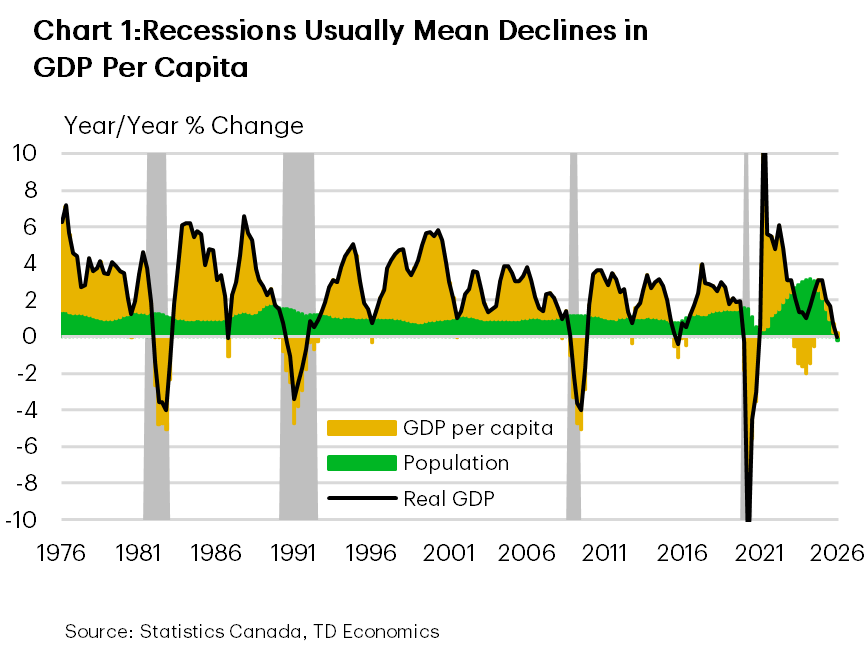
Large swings in population growth have made economic data harder to interpret. Earlier in the cycle, rapid population growth lifted GDP and helped absorb some of the drag from higher interest rates, even as falling GDP per capita and weak sentiment showed that many households and businesses were under strain. More recently, slower population growth has weighed on headline GDP, while per-capita measures have improved.
The conventional recession-versus-growth framing misses the more interesting story. Canada has absorbed a series of rolling shocks, with strain in one sector often cushioned by resilience in another. Housing and construction softened first, population-sensitive sectors adjusted next, and trade-exposed industries are now under pressure from tariffs and global uncertainty. The result has been a prolonged adjustment that shifted from sector to sector without becoming a broad-based recession.
New shocks could still disrupt the recovery, particularly if trade tensions intensify. But the economy’s ability to absorb these shocks without tipping into a broad-based recession is reason for cautious optimism. That optimism would strengthen if investment begins to broaden. As earlier drags fade, growth should become more durable, more capital intensive, and more visible in per-capita measures and industry participation.
Population Growth Lifted GDP While Conditions Weakened
Headline GDP has been unusually difficult to interpret in this cycle. Rapid population growth boosted aggregate output in the early post-pandemic years, helping Canada avoid an outright decline in GDP even as underlying conditions softened. This was not just a measurement issue. By adding consumers, workers, students, and renters, the population surge helped sustain demand while higher interest rates weighed on large parts of the economy. GDP per capita told a different story, declining year-on-year through 2023 and 2024, a pattern normally associated with recessionary periods (Chart 1).
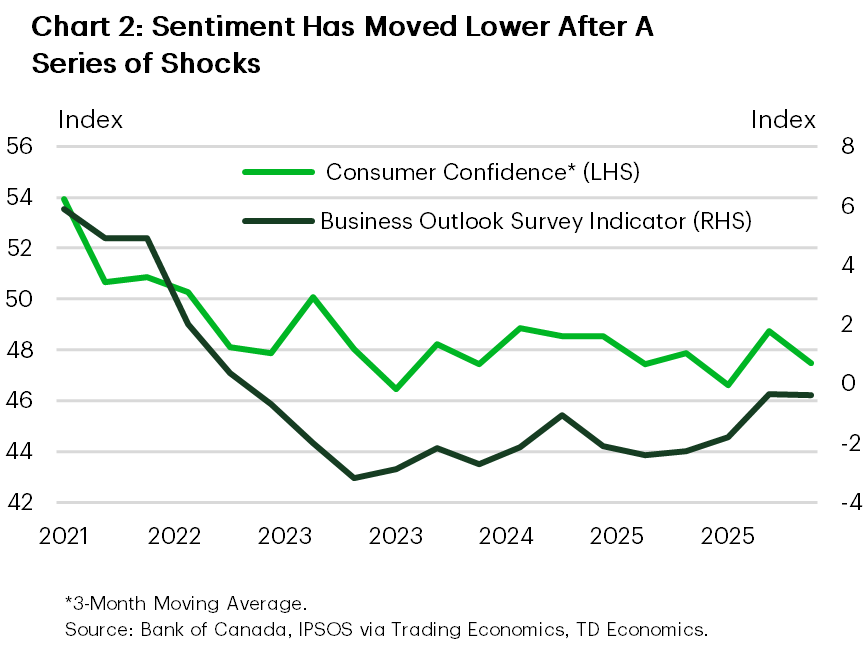
That disconnect explains why sentiment weakened even as headline data looked more resilient. Higher borrowing costs, rising uncertainty, and falling per-capita income left households and businesses increasingly strained. Business sentiment fell sharply in 2023 and struggled to regain momentum. Consumer sentiment followed a similar path (Chart 2).
The population story has now turned. A declining population is now weighing on headline GDP, which was down 0.2% year-on-year in the first quarter of 2026, while per-person GDP remained positive. This does not mean the economy has suddenly become strong. It means the distortion has changed direction. Headline GDP and per-capita measures now need to be read together to understand the underlying cycle.
A Sequence of Shocks Prolonged the Slowdown
Canada’s slowdown has unfolded in stages. Just as one source of weakness began to fade, another emerged, preventing the recovery from gaining sustained momentum.
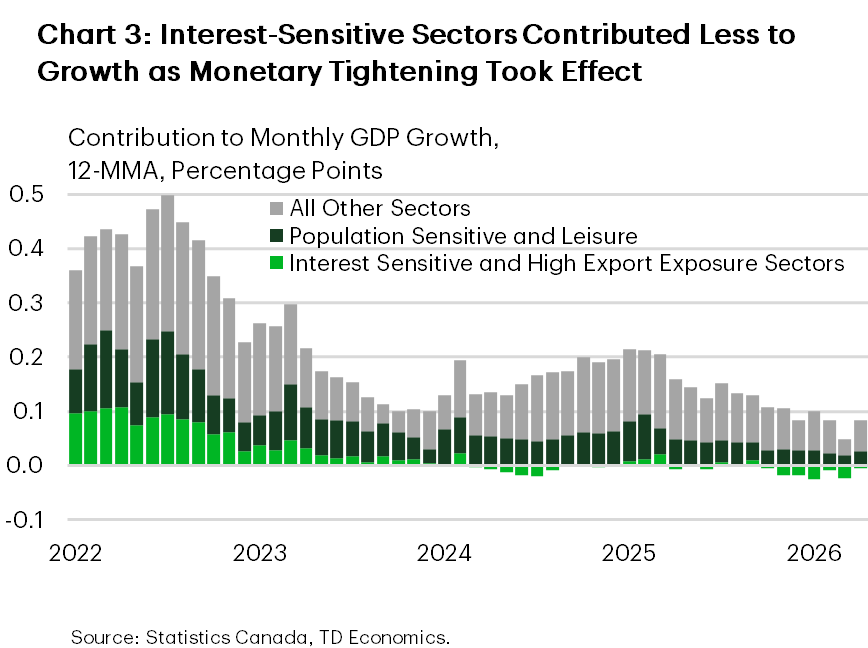
The first shock came from higher interest rates. Rapid monetary tightening hit the most rate-sensitive parts of the economy first, particularly housing and durable goods (Chart 3). These sectors weakened as borrowing costs rose and sales tumbled. At the same time, rapid population growth supported spending elsewhere, cushioning the impact on aggregate growth.
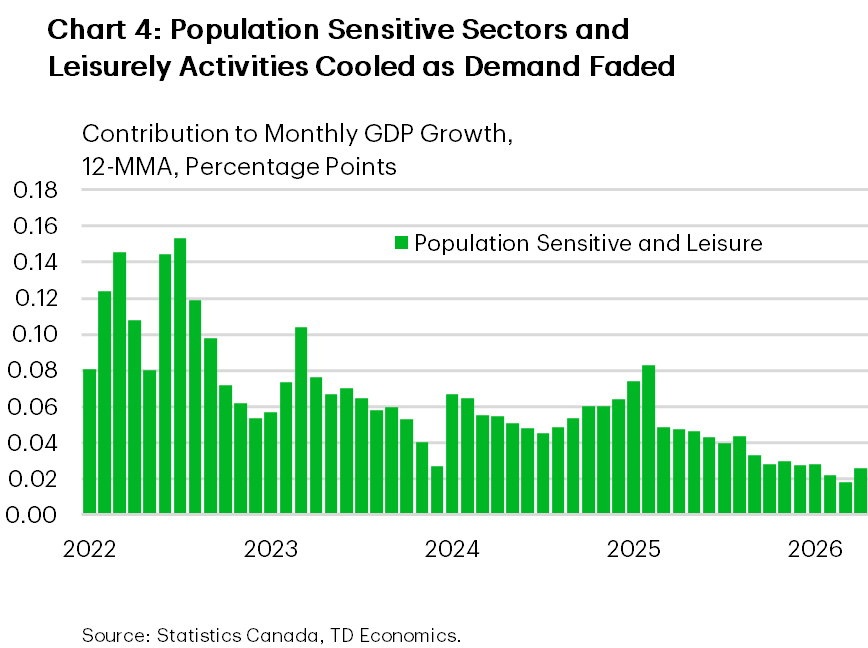
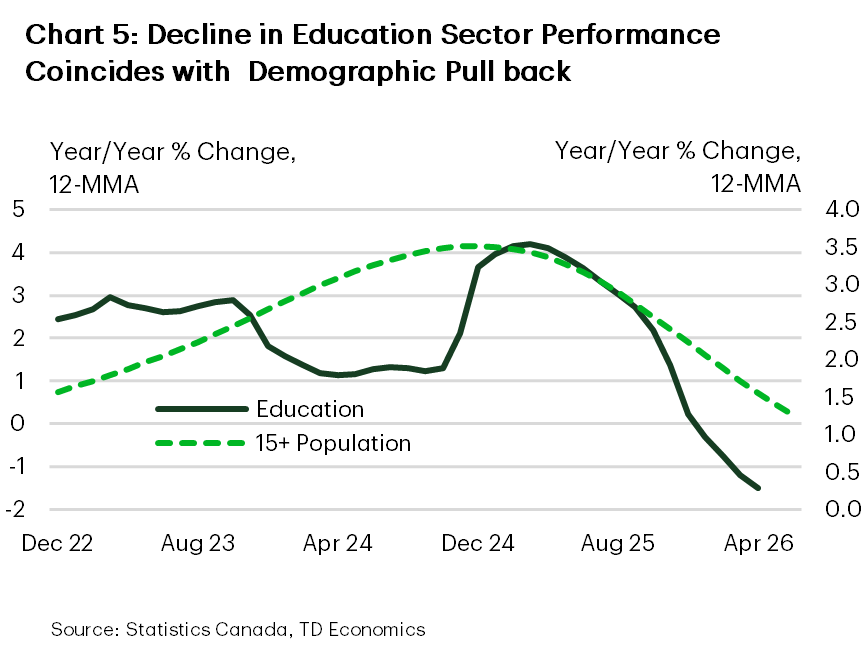
That support eventually faded. As the government lowered targets for both permanent and temporary residents and raised the financial requirements for international students, population-driven sectors weakened (Chart 4). With approved student permits down by about 35% from previous years, the education sector bore the brunt of this adjustment (Chart 5).
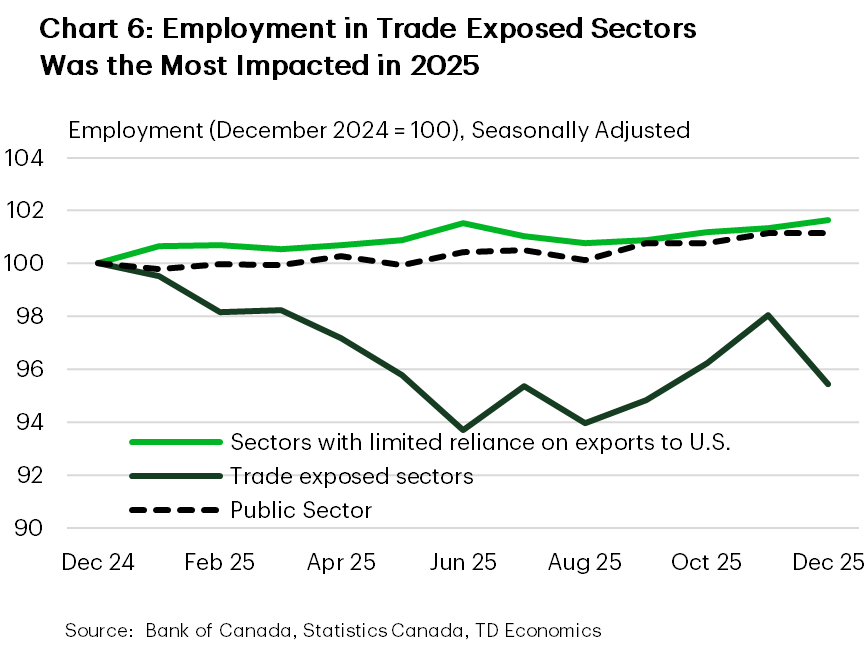
The most recent shock has been to trade. Trade-exposed industries have faced growing pressure since early 2025, as escalating trade tensions with the United States have weighed on exports and business investment. Manufacturing output has fallen and employment in export-oriented industries has weakened as firms adjust to a more uncertain trading environment (Chart 6).
The sharp decline in export volumes is unlikely to be repeated over the coming year, as much of the adjustment has already occurred. However, trade-related uncertainty remains elevated. The U.S. government recently announced plans, under Section 338 of the Tariff Act, to impose an additional 50% tariff on selected Canadian exports. Until there is greater clarity on the future trading environment, businesses are likely to remain cautious.
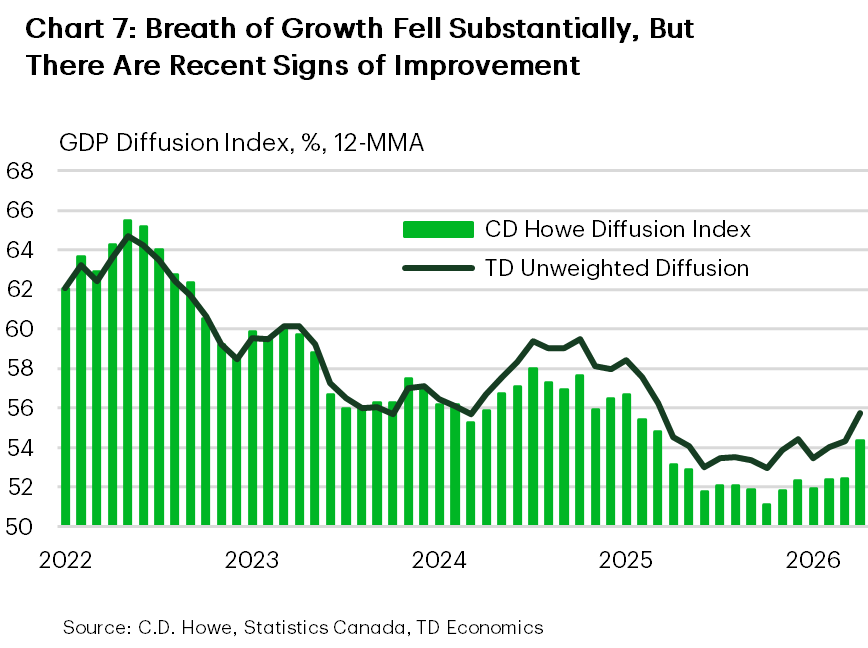
Taken together, these shocks explain why the economy has felt weak for so long without meeting the usual markers of a broad recession. Interest-sensitive sectors weakened first, population-sensitive sectors adjusted next, and trade-exposed industries are now absorbing a new kind of pressure. As a result, growth is being driven by a narrower group of industries (Chart 7), leaving the economy vulnerable even as it avoids a synchronized downturn.
How We Will Know the Adjustment Is Ending
The outlook depends on whether the sources of pressure continue to fade and whether the sources of resilience broaden. The drag from higher interest rates has largely run its course. Population growth will stabilize once the adjustment in non-permanent residents is complete. Trade disruptions may prove more persistent, but the latest tariffs are targeted and affect a limited share of Canada’s trade with the United States. A stronger investment cycle would add another layer of support.
The recovery is likely to be gradual, as the effects of recent shocks fade at different speeds. Still, growth should improve as earlier headwinds ease and Canada’s sources of resilience become more visible. That includes stronger per-capita growth, broader industry participation, and continued support from the natural resource sector.
In the immediate future, while the population adjustment continues, stronger growth in GDP per capita will be an important sign that conditions are improving beneath the headline. But it should not be the only test. The broader question is whether the gap between headline economic performance and the lived experience of households and businesses begins to narrow. As population growth normalizes, the focus should shift from whether total GDP rebounds in any single quarter to whether growth becomes broad enough and durable enough to be felt across the economy.
The Bottom Line
Canada’s recent experience has not fit neatly into the usual recession-or-growth framework. Rapid population growth helped keep aggregate GDP from falling when higher rates first hit, but it also made the economy look healthier than many households and businesses experienced. Now that population growth has slowed, the reverse risk has emerged: headline GDP is weaker than underlying indicators suggest.
That is why the technical recession label is incomplete. Canada did not experience a classic, synchronized downturn. It has moved through a sequence of adjustments, with rate-sensitive sectors weakening first, population-sensitive sectors adjusting next, and trade-exposed industries now facing ongoing uncertainty.
The next stage should look better if fewer parts of the economy are hit by new challenges at the same time. But the standard should be higher than a rebound in headline GDP. The economy will feel healthier only when growth becomes broader, more durable, and more visible in the conditions facing households and businesses.
Disclaimer
This report is provided by TD Economics. It is for informational and educational purposes only as of the date of writing, and may not be appropriate for other purposes. The views and opinions expressed may change at any time based on market or other conditions and may not come to pass. This material is not intended to be relied upon as investment advice or recommendations, does not constitute a solicitation to buy or sell securities and should not be considered specific legal, investment or tax advice. The report does not provide material information about the business and affairs of TD Bank Group and the members of TD Economics are not spokespersons for TD Bank Group with respect to its business and affairs. The information contained in this report has been drawn from sources believed to be reliable, but is not guaranteed to be accurate or complete. This report contains economic analysis and views, including about future economic and financial markets performance. These are based on certain assumptions and other factors, and are subject to inherent risks and uncertainties. The actual outcome may be materially different. The Toronto-Dominion Bank and its affiliates and related entities that comprise the TD Bank Group are not liable for any errors or omissions in the information, analysis or views contained in this report, or for any loss or damage suffered.
Download
Share: