Highlights
- Alberta’s proposed West Coast oil pipeline has moved into a more concrete phase, seeking designation as a project of national interest by October 1, 2026.
- At roughly 1 million barrels/day, the proposed pipeline would materially expand Canada’s crude export capacity by close to 20%, improve market access to Asia and price realization for Canadian oil.
- The economic benefits could be substantial though execution, financing and regulatory approvals remain key risks.
- The pipeline is linked to the Pathways carbon capture and storage project. It ties expanded crude export capacity to a broader oil sands emissions reduction strategy supported by fiscal incentives, carbon pricing reforms and carbon contracts for difference.
Recent federal–Alberta developments have advanced two intricately linked initiatives: a proposed West Coast oil pipeline alongside a parallel emissions reduction strategy in the oil sands.
On the former, Alberta has submitted its proposal for the new pipeline, marking a pivotal step toward expanding the country’s export infrastructure. The application seeks designation as a project of national interest under the federal Major Projects Office (MPO) framework – the agreement is targeting a decision by October 1, 2026. The submission follows months of negotiations and reflects a growing degree of political alignment for a major energy project, even with many technical details pending.
Meanwhile, under the federal-Alberta agreement, progress on the oil pipeline is linked to the Pathways Project. This is a large-scale carbon capture, transportation and storage network intended to reduce emissions from Alberta’s oil sands sector. Pathways has also been submitted to the MPO and is currently designated as a transformative strategy, which denotes early stage initiatives. The two governments have announced measures aimed at improving the investment case for emissions reduction technologies. These include enhanced tax incentives for carbon capture expenditures, minimum credit creation for carbon capture and storage projects under the federal Clean Fuel Regulations, reforms to Alberta’s industrial carbon market and the introduction of carbon contracts for difference.
Oil Pipeline Proposal Details
A key question heading into the announcement was whether private sector funding plans would be present. Indeed, a private-sector participant has emerged, though the commercial structure remains only partly defined. Alberta says it has entered into a non-binding agreement with Pembina Pipeline Corporation in conjunction with arms-length organizations Trans Mountain Corporation (TMC) and the Alberta Petroleum Marketing Commission (APMC) to further develop the project. Pembina’s economic interest would be 10% through construction, with the opportunity to add up to 10% once the pipeline enters commercial operation, while TMC and APMC would own equal shares of the balance.
Pembina’s role is best understood as an early strategic investor and commercial partner rather than a fully committed standalone sponsor. Broader private-sector investment is expected to trickle in over time, though key pieces such as producer shipping commitments, a finalized ownership structure, and Indigenous equity participation need more clarity before that happens.
The pipeline’s proposed route is also clearer. The proposal highlights the new heavy oil pipeline running from a receipt terminal in the Bruderheim area of Alberta to a marine export terminal at Roberts Bank in British Columbia. The project would follow the existing Trans Mountain corridor along a southern route, with two candidate alignments (an “Original Corridor” and an “Optimized Corridor”) still under study. The route choices are strategically important because they build on existing infrastructure where possible and avoid the need to revisit the federal northern tanker moratorium. Even so, the final alignment remains subject to further engineering, environmental review, and consultation with Indigenous communities.
The proposal also embeds the pipeline within a broader climate and policy framework. In parallel with the submission, Alberta and the federal government have finalized a carbon pricing pathway for large emitters. The industrial carbon price will remain at $95/tonne of carbon dioxide equivalent emissions until the end of 2026 and will rise to $140/tonne by 2040. Ottawa, Alberta and the oil sands producers participating in the related Pathways/Oil Sands Alliance have also set an objective of delivering 16 million tonnes per year of emissions reductions by 2045.
Timelines outlined in the submission are ambitious, but achievable under a best case execution path. Under this baseline, construction could begin as early as late 2027, with a final investment decision (FID) by 2028-29, and the first oil flows expected by 2032-2034. However, these timelines remain contingent on several factors, including alignment with British Columbia, resolution of legal and environmental challenges, and completion of Indigenous consultations.
Pipeline Economics
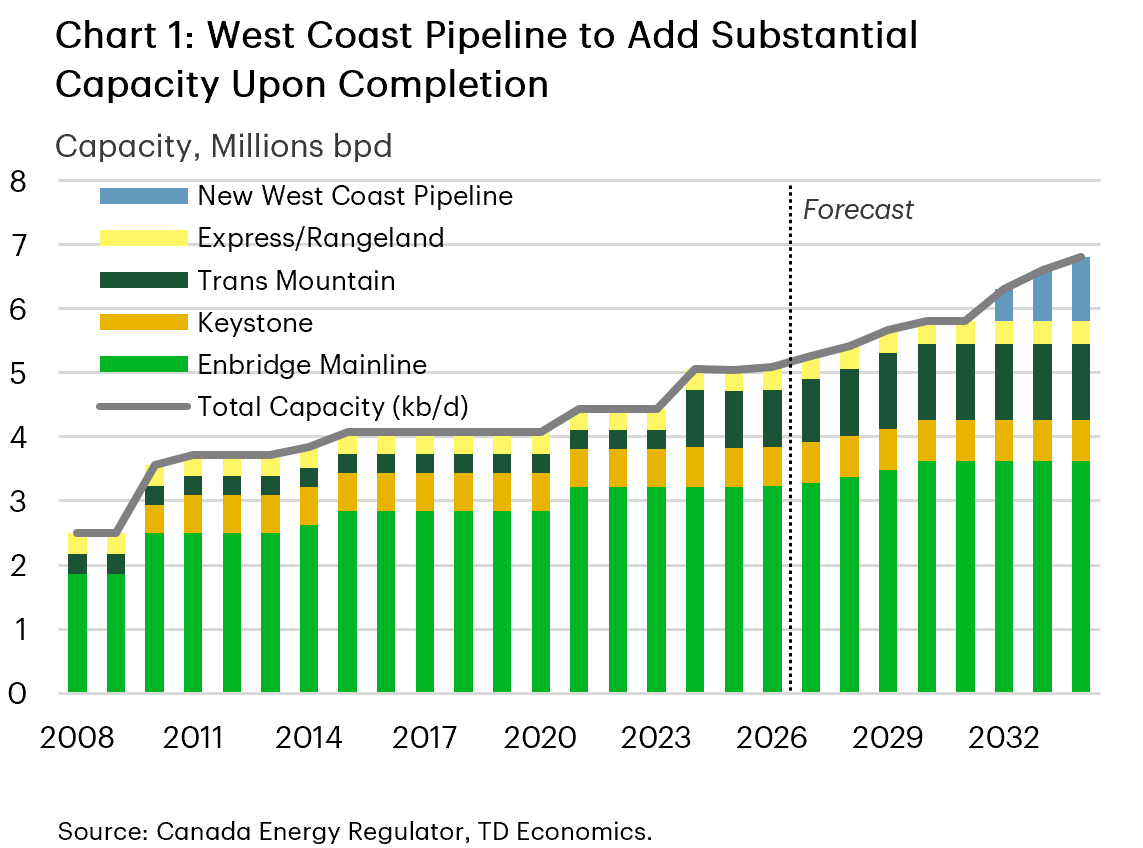
At roughly 1 million barrels per day (bpd) of capacity, the proposed pipeline would be transformative in scale. For context, the Trans Mountain Expansion (TMX) added approximately 590,000 bpd of capacity – bringing the current total to 890,000 bpd – when it entered service in 2024. Meanwhile, the Enbridge Mainline system, Canada’s largest oil pipeline, currently moves just over 3 million bpd. A new westbound pipeline of this size would increase Canada’s total crude export capacity by close to 20% and more than double the volume of oil able to reach tidewater for overseas shipment (Chart 1). In national terms, it would reduce some of Canada’s dependence on the U.S. market, which still absorbs the vast majority of Canadian crude exports. The pipeline itself is estimated to cost $35-44 billion.
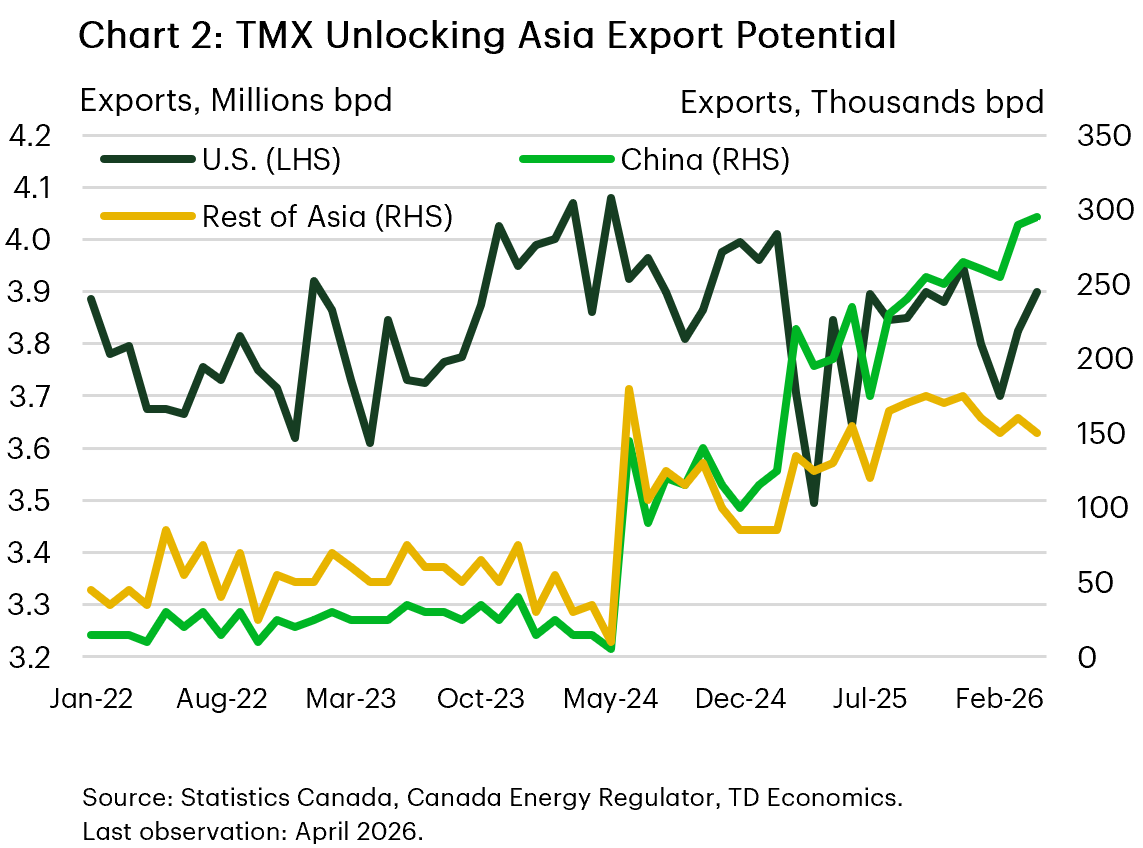
The economic rationale for a new pipeline rests largely on market access and price realization rather than new incremental production alone. Alberta’s submission argues that Asian demand would likely dominate much of the new pipeline’s throughput in the 2030s. Even as growth slows, Asia (led by China) is expected to remain the world’s largest oil importer over the next decade. Chinese refineries are among the few that can process Alberta’s heavy crude at scale and have already emerged as major buyers of Canadian oil via the TMX pipeline. By late 2025, China was importing over 200,000 bpd of Canadian crude, surpassing the U.S. as the top buyer of seaborne volumes (Chart 2).
Other complex Asian refiners in markets like Japan and South Korea have also emerged as key sources of demand. Asia’s willingness to absorb Canadian barrels reflects a longer run diversification strategy aimed at securing stable supply from non Middle Eastern sources. Even so, a bit of caution is warranted. Asia’s oil use is expected to flatten over time as Chinese demand approaches a peak over the next decade, driven by rapid EV adoption and a gradual shift toward cleaner energy.1 Further, Canadian heavy barrels will continue to face competition from discounted alternatives such as Russian crude.
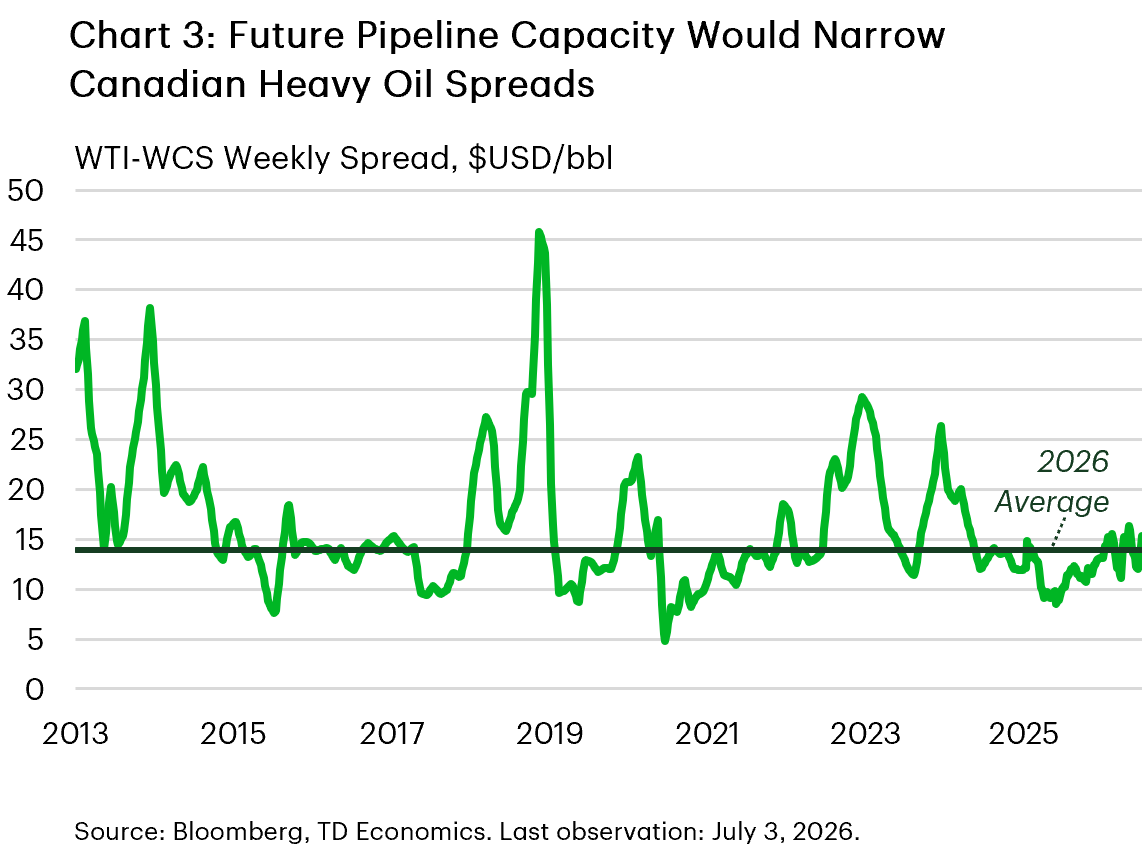
On price realization, the new pipeline could narrow the discount between Canadian heavy oil and U.S. benchmark crude by up to US$3 per barrel over time. That direction is consistent with the post-TMX experience where the WTI–WCS differential averaged about US$12 per barrel after TMX entered service, well below the extreme blowouts seen during earlier bottlenecks (Chart 3). These relative price spreads underscore the importance of export access for Canadian heavy oil. Historically, limited pipeline capacity widened the WTI–WCS differential, eroding realized prices. In practice, the new line would have no near-term effect on spreads before construction and commissioning. But once in service, added tidewater capacity should work to structurally tighten WCS discounts over time by reducing the risk of future bottlenecks.
Macro Impacts
The macroeconomic implications are potentially significant, though highly conditional and longer run in nature. Alberta government estimates suggest construction spending for the pipeline and related upstream activity could total $70 billion to $81 billion between 2026 and 2038, lifting Canadian real GDP by about 0.4% in the early 2030s and supporting up to 140,000 jobs at peak, including roughly 45,000 in Alberta and 70,000 in British Columbia.2 Over the longer term, the same government analysis points to Canadian real GDP being more than 0.6% higher annually by the 2040s (rising above 0.7% with broader spillovers), with Alberta’s economy more than 3.5% larger on average, supported in part by higher oil production and improved price realization.
While these figures provide a useful benchmark, they should be viewed as proposal-stage estimates from proponents and governments with a clear interest in advancing development, and therefore may lean optimistic. However, a back-of-the-envelope cross-check using comparable projects and more conservative assumptions would still imply a meaningful impact in the order of $25–40 billion in cumulative construction and a steady-state Canadian GDP lift closer to 0.3% (and ~2% in Alberta). Fiscal gains would accrue through higher royalties and taxes, potentially in the hundreds of millions to low billions annually, depending on production and price sensitivities.
Even if the realized impacts fall shy of official government estimates, the project would still represent a meaningful contribution to growth, particularly when combined with improving market access and export diversification.
Carbon Capture at the Centre of Reducing Oil Sands Emissions
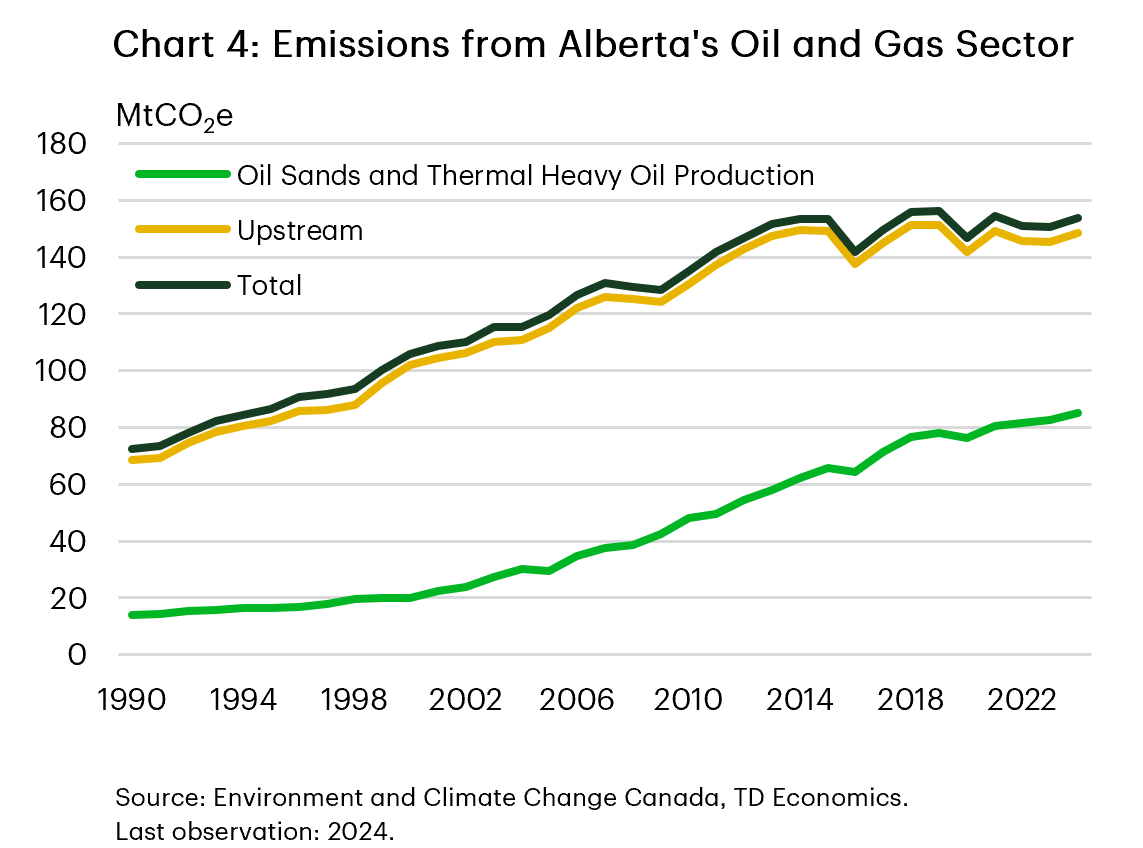
While the oil pipeline proposal is being framed around market access and macroeconomic gains, its political viability is also tied to progress on emissions reduction from the oil and gas sector. That makes the Pathways Project a central part of the broader federal-Alberta bargain. The oil and gas sector is the largest emitting economic sector, accounting for around 30% of Canada’s greenhouse gas emissions.3 Although emissions from Alberta’s oil and gas sector have stabilized over the past decade, the slowdown was almost entirely driven by reductions in methane emissions. In contrast, carbon dioxide emissions have been rising, especially from oil sands and thermal heavy oil production, which is where the Pathways Project is expected to make an impact (Chart 4).
Initially announced in 2021, Pathways is expected to include a more than 650-kilometer pipeline network and a storage hub located 1-2 kilometers underground in the Cold Lake region.4 In addition to the transportation and storage infrastructure, Oil Sands Alliance members, who are the proponents of the Pathways Project, will be individually responsible for carbon capture infrastructure at their respective oil sands facilities. The alliance is a coalition of five leading oil sands companies – Canadian Natural Resources, Cenovus Energy, ConocoPhillips Canada, Imperial Oil and Suncor Energy – which together account for around 90% of oil production in Alberta.
Under the Memorandum of Understanding (MOU) between Alberta, Canada and the Oil Sands Alliance, Pathways is expected to capture and store at least 6 million tonnes (Mt) of carbon dioxide per year by 2035 and ramp up to 11 Mt by 2040 and 16 Mt by 2045.5 Companies may use other technologies alongside carbon capture although at least 6 Mt of annual reductions must come from carbon capture. By comparison, Alberta government estimates suggest the proposed pipeline could increase upstream emissions by 15.5–18.2 Mt annually between 2032 and 2041.6 In addition, the emissions target in the MOU is lower than the 22 Mt per annum by 2030 that the project proponents had originally hoped to achieve.7 That said, even the lower target of 16 Mt, if it can be achieved, is still meaningful as it represents nearly a fifth of current greenhouse gas emissions from Alberta’s oil sands sector.
Government Financial Incentives Likely Central to Pathways Viability
The Pathways Project is likely to have large upfront capital costs, with earlier estimates putting the cost at around $16.5 billion8 while more recent estimates suggest at least $20 billion9 could be spent. The combination of high capital expenditures and relatively limited commercial revenue options has led the Alberta and federal governments to commit support for capital and operating costs for Pathways and other CCUS projects.
A key part of the support package is direct fiscal assistance to reduce the upfront capital burden of carbon capture projects. The announced measures include an extension of current rates of the federal carbon capture, utilization and storage (CCUS) investment tax credit to 2035 instead of cutting them by half after 2030 (for the period from 2031 to 2040) as previously planned. Companies are eligible to receive a 50% tax credit on qualified spending related to capturing carbon dioxide from oil production facilities and a 37.5% tax credit for qualified carbon dioxide transportation, storage and use costs. The federal government has confirmed enhanced oil recovery will be eligible for the CCUS tax credit at half the standard credit rates, consistent with the 2026 Spring Economic Update. In addition, Alberta has made a commitment to finalize its carbon capture incentive program that will provide a grant that covers 12% of eligible CCUS capital expenditure.
The two governments have also announced measures aimed at offsetting operating costs for CCUS projects. These include a minimum credit creation rate of 20% under the federal Clean Fuel Regulations (CFR) even when the standard CFR methodology would otherwise generate fewer credits. With average quarterly CFR credit prices for traded credits ranging from $93 to $217 in 2024 and 2025, these credits could become an important revenue stream for CCUS projects. Carbon price certainty is also central to CCUS project economics, and Alberta and Canada have committed under their May 2026 Implementation Agreement to provide greater certainty around future carbon prices.10
Carbon Pricing Reforms to Also Support Emissions Reduction Investment
The two governments have agreed to reform Alberta’s industrial carbon market by establishing a new policy price trajectory. Under the IA, the policy price – the benchmark compliance price set by regulation – will now increase from $95/tonne of carbon dioxide equivalent emissions in 2026 to $115 by 2030 and $140 by 2040. This is lower than the previous target which required the price to reach $170 by 2030 (Chart 5). Under Alberta’s Technology Innovation and Emissions Reduction (TIER) program, facilities that do not meet emissions standards can fulfill their compliance obligations by buying credits directly from the TIER Fund at the policy price. Alternatively, they can purchase credits from other facilities that outperform the emissions standards and pay bilaterally negotiated prices, which can differ from the regulated policy price, as we discuss below. There is a limit though to the share of a facility’s compliance obligations that can be met with traded credits (80% in 2025 and 90% from 2026 onwards).
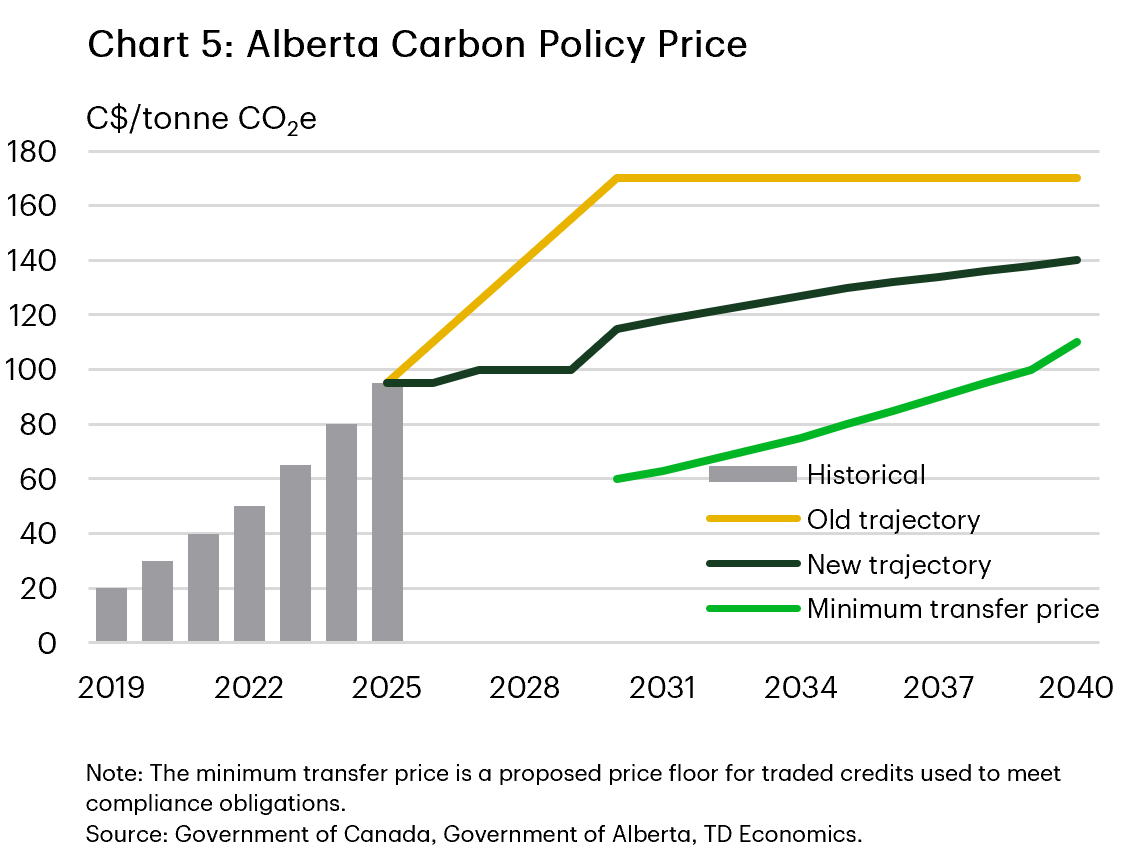
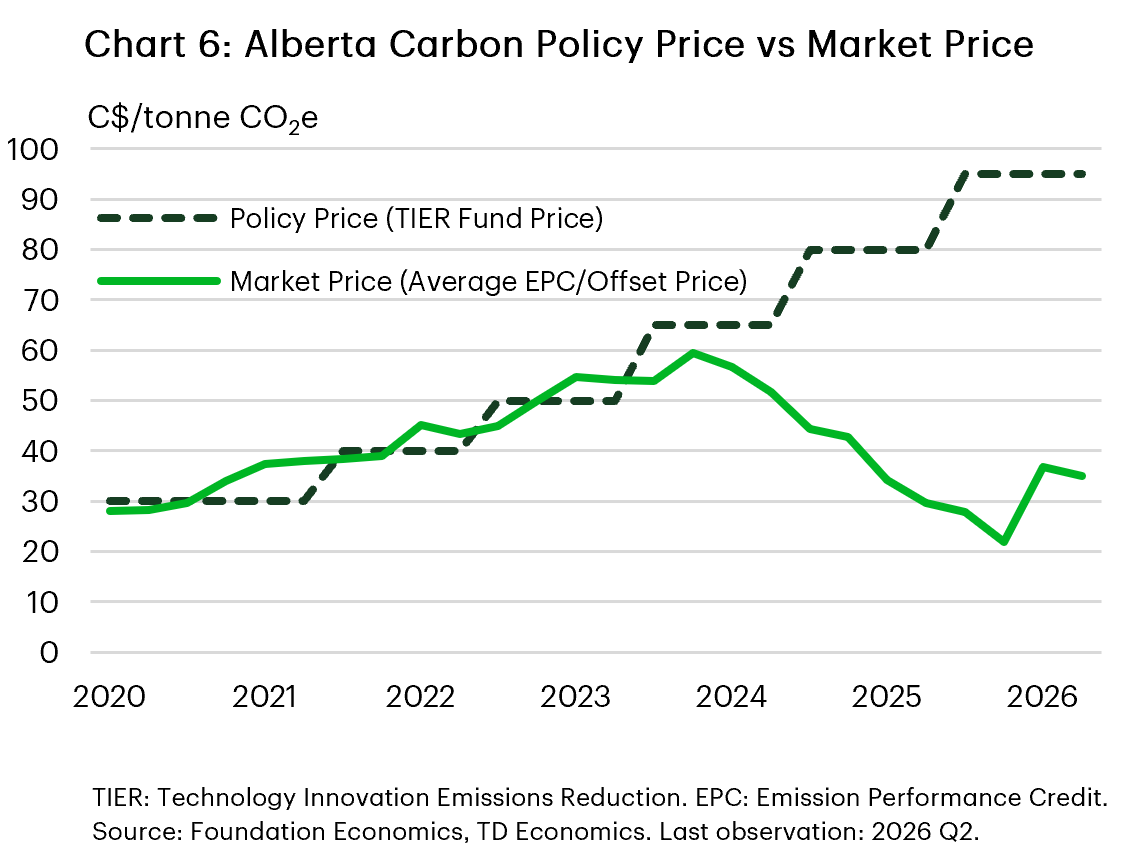
In the first three years after TIER became effective, the policy and market prices were largely aligned. However, the two have disconnected in recent years as market prices have fallen due to an oversupply of credits, reaching around a third of the policy price in the past year (Chart 6). Low market prices likely encourage companies to fulfill the bulk of their compliance obligations with traded credits rather than pay into the TIER Fund, making the effective carbon price they pay much lower than the regulated policy price. The Alberta government has committed to narrow this gap by ensuring that the market price rises over time and reaches $130/tonne by 2040. Also, Alberta plans to pass new regulation by year-end to establish a price floor for traded credits used to meet compliance obligations that will start at $60/tonne in 2030 and increase to $110 by 2040. For emissions reduction investments like carbon capture and storage whose main source of revenue is compliance credits, strengthening carbon prices can boost project financial viability.
Moreover, Alberta and Canada plan to provide more price certainty through carbon contracts for difference (CfDs), which are two-way contracts under which the government would pay the difference if carbon prices fell below an agreed level and receive payment otherwise. The two governments will issue CfDs that cover up to 75 million tonnes of CO2 cuts to companies investing in emissions reduction technologies from 2030 to 2040, with the total cost exposure capped at $1.2 billion split evenly between Alberta and Canada. However, if either government gets rid of its carbon price policy, then it would assume the entire liability of the CfDs.
There is still considerable uncertainty around how Alberta will move market credit prices higher over time or how it will ensure the proposed minimum transfer price becomes binding in practice. This will be challenging given the current large bank of credits in the TIER market and the fact that new credit creation exceeds credit retirements.11 Without stronger measures to tighten supply or increase compliance demand, the wide gap between policy and market prices could continue. This raises a fiscal risk that if market prices fail to rise as expected, CfDs could be triggered more often and for larger amounts, potentially testing whether the stated $1.2 billion cap fully limits government exposure.
TD Economics Perspective
The likelihood of the pipeline project being designated as a project of national interest is high. Beyond the economic merits, political considerations are clearly aligned: both federal and provincial governments have tied broader economic and policy objectives to the advancement of this project. As one of the largest initiatives to move through the new Major Projects Office (MPO) framework, its progression will serve as an important test case. A relatively smooth path from proposal to construction and operation would help validate the MPO process, set a precedent for other large-scale infrastructure projects, and potentially catalyze additional private investment across sectors.
The proposed corridor-based routing strategy is also necessary to improve the project’s feasibility, particularly given the challenges faced by past pipeline proposals. By largely following the existing Trans Mountain path, either the “Original” or “Optimized” corridor would reduce regulatory complexity and leverage existing infrastructure.
More broadly, the pipeline-Pathways linkage offers an informative example of the potential for intersection between economic and environmental policy. By pairing expanded export capacity with an emissions reduction strategy, the project attempts to align near-term economic gains with longer-term climate commitments. Indeed, execution risk remains high, though the framework suggests a shift toward a more integrated project design, where development and emissions mitigation are advanced in tandem. If successful, this approach could serve as a model for future resource projects navigating increasingly complex economic and environmental constraints.
Although Pathways would not be the oil sands sector’s first carbon capture prcloject, it would represent a step change in the scale of Alberta’s carbon transportation and storage infrastructure. By establishing a much larger shared network than currently exists, Pathways could help lay the foundation for future CCUS investments in the sector and beyond. This broader infrastructure potential is important as interest in carbon capture is already emerging across Alberta’s industrial base, with proposed projects in areas such as cement and petrochemicals manufacturing. In that sense, Pathways could have strategic value beyond its direct emissions reduction by helping position Alberta as a CCUS hub.
End Notes
- International Energy Agency, Oil 2025: Analysis and forecast to 2030, June 17, 2025
- Government of Alberta, West coast oil pipeline project : submission by the Government of Alberta to the Major Projects Office for listing under the Building Canada Act, July 2, 2026
- Environment and Climate Change Canada, Canada’s Official Greenhouse Gas Inventory: Data by Economic Sector, April 14, 2026
- Oil Sands Alliance, Pathways Project
- Government of Canada, Memorandum of Understanding, July 13, 2026
- Government of Alberta, West coast oil pipeline project : submission by the Government of Alberta to the Major Projects Office for listing under the Building Canada Act, July 2, 2026
- Pathways Alliance, A Brief on Clean Technology in Canada: Submitted to the House of Commons Standing Committee on Environment and Sustainable Development, October 24, 2022
- Government of Alberta, Pathways Alliance Carbon Capture Storage Hub (Phase 1)
- Emma Graney and Marieke Walsh, Ottawa nearing major projects deal with B.C. as Alberta closes in on West Coast pipeline proposal, The Globe and Mail, June 26, 2026
- Government of Alberta and Government of Canada, Implementation Agreement for the Canada-Alberta Memorandum of Understanding of November 27, 2025 between the Government of Canada and the Government of Alberta, May 15, 2026
- Foundation Economics, Alberta TIER 2024 Compliance results: Implications for a growing EPC/Offset bank, November 3, 2025
Disclaimer
This report is provided by TD Economics. It is for informational and educational purposes only as of the date of writing, and may not be appropriate for other purposes. The views and opinions expressed may change at any time based on market or other conditions and may not come to pass. This material is not intended to be relied upon as investment advice or recommendations, does not constitute a solicitation to buy or sell securities and should not be considered specific legal, investment or tax advice. The report does not provide material information about the business and affairs of TD Bank Group and the members of TD Economics are not spokespersons for TD Bank Group with respect to its business and affairs. The information contained in this report has been drawn from sources believed to be reliable, but is not guaranteed to be accurate or complete. This report contains economic analysis and views, including about future economic and financial markets performance. These are based on certain assumptions and other factors, and are subject to inherent risks and uncertainties. The actual outcome may be materially different. The Toronto-Dominion Bank and its affiliates and related entities that comprise the TD Bank Group are not liable for any errors or omissions in the information, analysis or views contained in this report, or for any loss or damage suffered.
Download
Share: