GTA Resale Condo Market Outlook:
A Long Correction with Stabilization on the Horizon
Rishi Sondhi, Economist | 416-983-8806
Date Published: May 7, 2026
- Category:
- Canada
- Real Estate
Highlights
- Benchmark GTA resale condo prices fell 10% y/y in 2026Q1, and subdued demand relative to supply suggests further price declines through 2026.
- Next year, better affordability, waning uncertainty, pent-up demand and firmer labour market conditions should lift sales and help draw down inventories, improving the trajectory for prices.
- With population growth weak, investor demand constrained, and interest rates unlikely to add much support, prices may not trend higher in earnest until 2028, leaving the downturn close to six years in total. By that time, prices will have fallen by around 25-30% from their early 2022 peak.
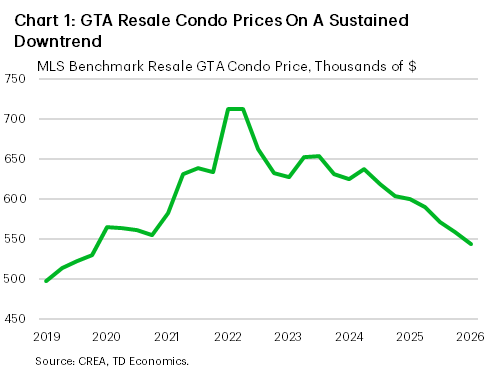
We’re 4 years into the price correction in the resale GTA condo market (Chart 1), marking the longest downturn the region has faced since the late-80s to mid-90s slump. That period of weakness spanned about 7 years before prices began to turn around. Will this more recent episode match that duration? We think it will come close.
In this note, we confine our analysis to the resale condo market. The market for newly built condos also faces significant challenges, although the recently announced cut to the HST on new homes for all buyers and the plan to reduce development charges on newly built homes should spur demand for new housing. However, these policies may exert modest downward pressure on resale activity, as demand shifts toward the new home market.
Resale Market to Keep Correcting This Year
Benchmark condo prices in the GTA resale market declined 10% year-on-year in the first quarter of 2026, marking the sharpest drop since the market began correcting in 2023 from elevated, pandemic-era prices. The imbalance behind the downturn persists, with demand levels insufficient to absorb elevated supply (Chart 2).
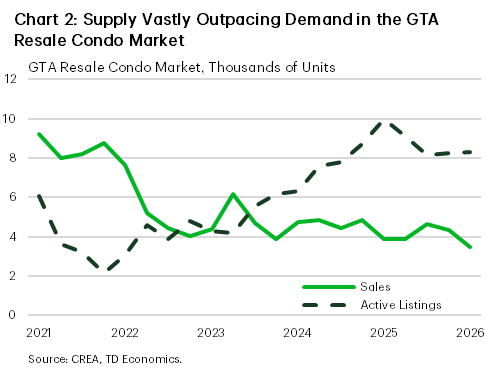
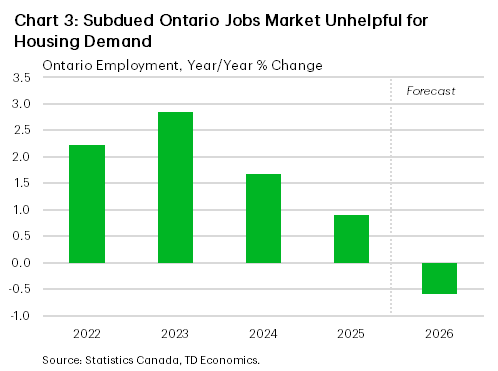
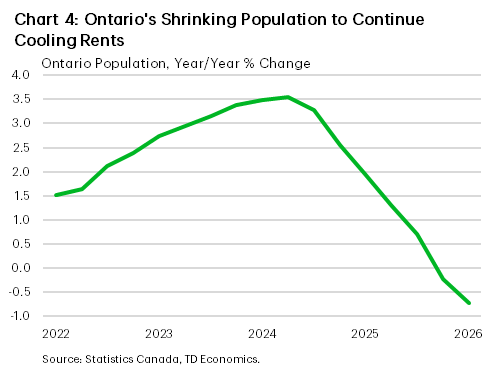
Condo resales were down 11% year-on-year in 2026Q1 and were some 40% below the 10-year average for the first quarter. The demand side of the picture will likely remain subdued for the rest of this year, with would-be buyers feeling squeezed by cost-of-living pressures1. In addition, economic uncertainty is highly elevated, and job growth should remain weak (Chart 3). Ontario’s population is also shrinking (Chart 4). This is downwardly pressuring rents, reducing the attractiveness of condos as investment assets and weighing on already-weak investor demand. Falling prices are also likely keeping buyers sidelined as they wait for further declines before purchasing.
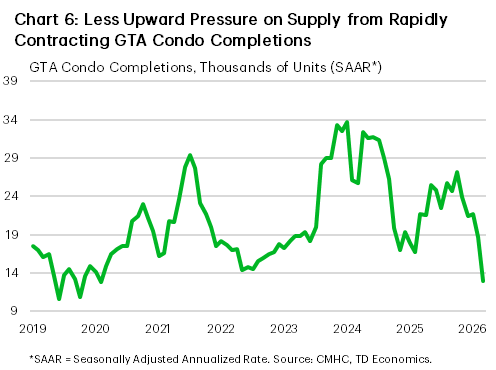
On the supply side, subdued sales levels mean that inventories will only be absorbed slowly. This means that supply should remain elevated for the remainder of the year, even as rapidly contracting condo completions add less upside pressure.
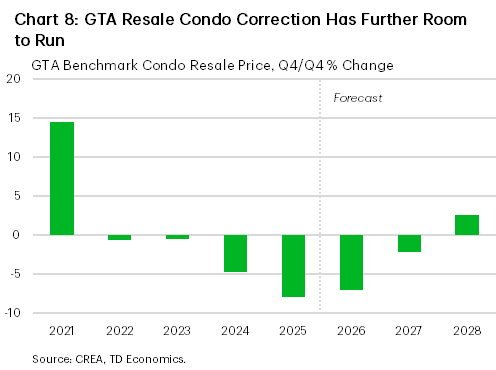
All told, we see prices falling around 6-7% this year on a Q4/Q4 basis, following an 8% decline in 2025.
Next Year Should See Some Improvement
We foresee an improved year for condo resales in 2027, aided by enhanced affordability. In March 2026, buyers could get a condo at a cost that prevailed in late 2019, and affordability will likely only improve further this year as prices continue to slide. What’s more, uncertainty should wane, boosting buyer confidence. Income growth should also pickup as the economy is supported by firm U.S. economic growth and solid government investment.
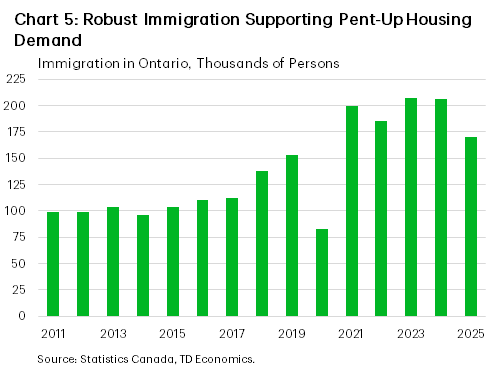
We also expect some support for sales from pent-up housing demand. Ontario has posted strong immigration for most of the past decade (Chart 5), and homeownership among newcomers typically increases with a lag—often taking about 10 or more years to converge toward the rate for the Canadian born population. If past patterns hold, some immigrants who arrived over the last several years should be entering the ownership market over the next few years. Even so, softer population growth should limit the rebound and keep sales well below pre-pandemic levels.
Rising sales activity should help absorb inventories while condo completions continue to be low (Chart 6). This should put resale inventories on a firm downtrend, helping rebalance the market. Indeed, condo prices could begin to stabilize in the back half of next year. That said, for the year overall, prices will have likely declined about 2-3% in Q4/Q4 terms.
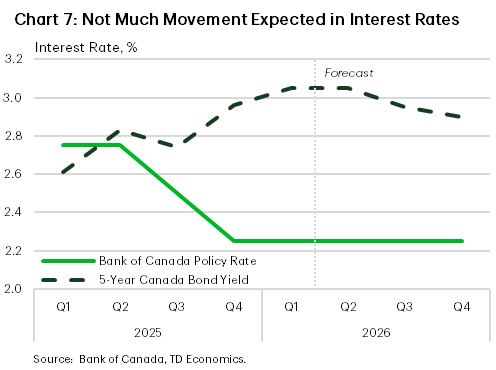
Mortgage rates are a hugely important determinant of housing demand. However, our forecast sees the Bank of Canada remaining on hold through next year (thus leaving interest rates on variable rate mortgages flat), with only a modest downdraft in government bond yields (which influence fixed mortgage rates) moving forward. Accordingly, interest rates are unlikely to add much support to demand (Chart 7).
Putting all the pieces together, it will likely take until 2028 before condo prices trend higher, in earnest (Chart 8), although the rate of increase could be around 3% - nearly tracking income growth. This profile would put the duration of this correction near 6 years – somewhat shy of the 80s-90s meltdown. Over this time, prices will have fallen by about 25-30% from their early 2022 peak, including an additional (roughly) 5-10% from 2026Q1 through the second half of 2027. The estimated peak-to-trough drop would be approximately in line with late 80s – 90s contraction, although that episode was measured in average prices due to data constraints.
There are both upside and downside risks to our call. For instance, energy prices could remain elevated for longer than we anticipate, squeezing household in¬comes and adding to the cost-of-living hurdles report¬ed by buyers. It’s also possible that pent-up demand returns to the market slower, in lesser quantity, or both, relative to what we expect. If demand is weaker-than-anticipated, that could lead to unsold supply staying on the market for longer than we expect.
On the upside, condo construction is rapidly retrench¬ing which could limit upside pressure on new supply by more than projected. It’s also possible that affordabil¬ity improvements unlock a larger amount of pent-up demand faster than anticipated.
Notably, the CUSMA negotiations also loom large for the broader economy and, by extension, the housing market.
Bottom line
We expect GTA resale condo prices to keep falling in 2026. The rate of decline should slow in 2027 as demand recovers, with prices only returning to a sustained uptrend in 2028 — keeping this correction one of the longest on record.
End Notes
- TRREB, “2026 Market Outlook and Year in Review: The Pressure Point – Housing Supply, Migration and the Missing Middle”. February 4, 2026. https://market-outlook.trreb.ca/
Disclaimer
This report is provided by TD Economics. It is for informational and educational purposes only as of the date of writing, and may not be appropriate for other purposes. The views and opinions expressed may change at any time based on market or other conditions and may not come to pass. This material is not intended to be relied upon as investment advice or recommendations, does not constitute a solicitation to buy or sell securities and should not be considered specific legal, investment or tax advice. The report does not provide material information about the business and affairs of TD Bank Group and the members of TD Economics are not spokespersons for TD Bank Group with respect to its business and affairs. The information contained in this report has been drawn from sources believed to be reliable, but is not guaranteed to be accurate or complete. This report contains economic analysis and views, including about future economic and financial markets performance. These are based on certain assumptions and other factors, and are subject to inherent risks and uncertainties. The actual outcome may be materially different. The Toronto-Dominion Bank and its affiliates and related entities that comprise the TD Bank Group are not liable for any errors or omissions in the information, analysis or views contained in this report, or for any loss or damage suffered.
Download
Share: